The 2026–27 Hindu wedding season opens after Dev Uthani Ekadashi on Friday, 20 November 2026, runs until about mid-December, pauses for roughly a month during Kharmas, and returns in full from mid-January to the end of February 2027. These few months hold most of the year's weddings, so venues, priests, tailors and boutiques all get busy at the same time. Knowing the dates early, and planning outfits around them, is the easiest way to avoid last-minute stress.
This guide brings together everything a bride, her family and wedding guests need: the wedding dates most panchangs agree on, what the weather means for fabrics in each month, an outfit plan for every function from haldi to reception, regional bridal traditions, a rough budget, and a shopping timeline that works backwards from the wedding day.
Quick answers:
- When does the wedding season start? After Dev Uthani Ekadashi on Friday, 20 November 2026. The first widely listed date is Saturday, 21 November.
- When is there a break? Many families avoid weddings during Kharmas, roughly mid-December to Makar Sankranti in mid-January, while the sun is in Sagittarius.
- Busiest months: late November and early December, then January and February 2027.
- What to wear in winter: silk, velvet and brocade for evening functions, raw silk and lighter silks for daytime, and a shawl or jacket for outdoor events.
- Exact muhurat: the time window depends on your city and family calendar, so always confirm the date and time with your priest.
The 2026–27 wedding season at a glance
The Hindu wedding calendar follows the movement of the sun and moon, not the school or office year. Here is how the coming season is shaped:
- Before 20 November 2026: Chaturmas, the four months when Lord Vishnu is believed to rest, is still running. Most families do not hold weddings in this period, although engagements and shopping often happen now.
- 20–21 November 2026: Dev Uthani Ekadashi and Tulsi Vivah. The symbolic wedding of Tulsi and Lord Vishnu opens the season.
- Late November to mid-December 2026: the first wave of weddings. Weather is pleasant in most of India, which makes this window popular for outdoor and destination weddings.
- Mid-December 2026 to mid-January 2027: Kharmas, also called Dhanurmas in Maharashtra and the South. Many communities pause weddings while the sun is in Sagittarius.
- Mid-January to February 2027: the peak. After Makar Sankranti the calendar fills again, and February is usually the busiest month of the season.
- March 2027 onwards: fewer dates around Holashtak before Holi, then a smaller spring and summer season.
If you are planning several functions over three or four days, check that every day you need falls in an open window, not only the main wedding day.
Wedding dates 2026–27 most panchangs agree on
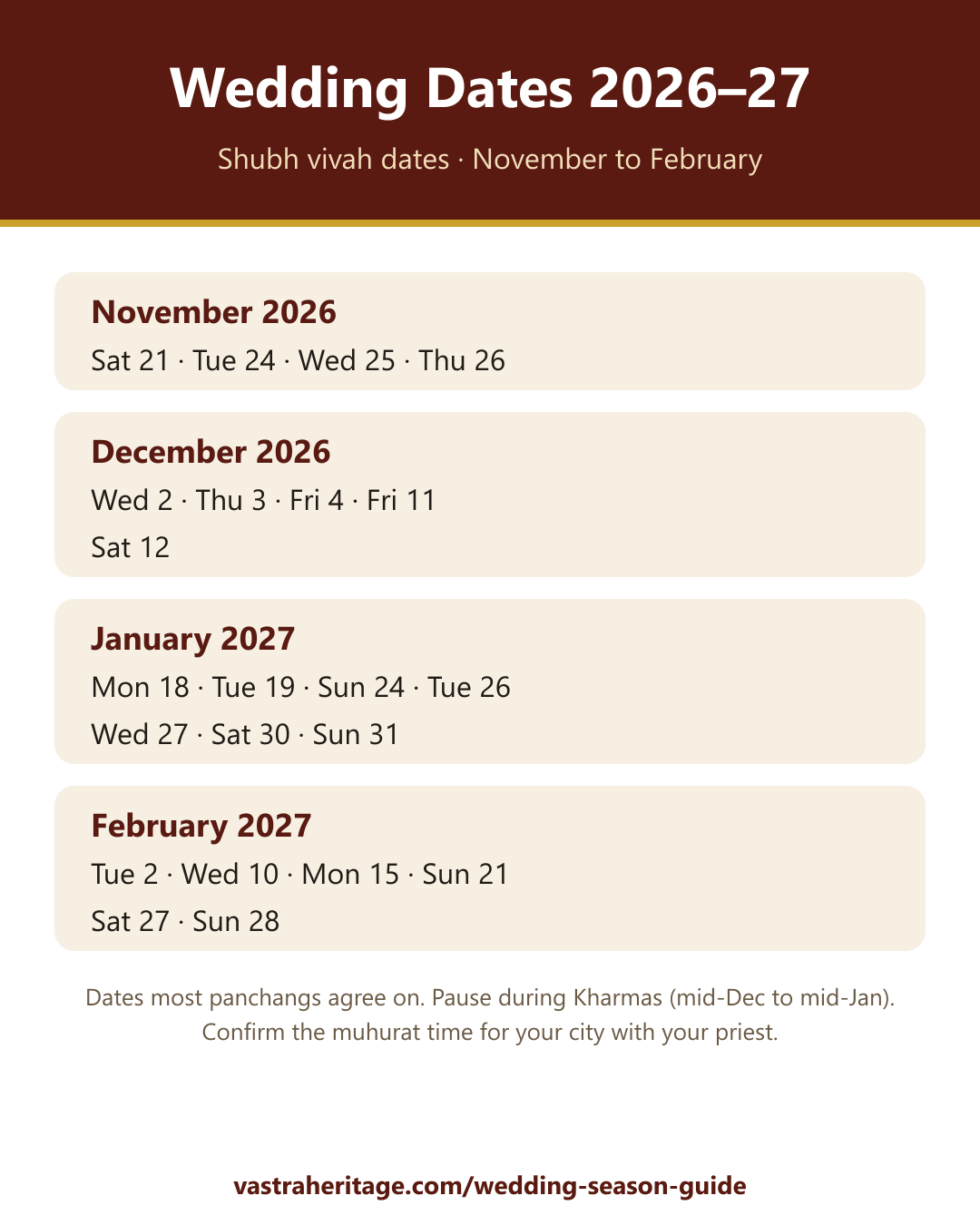
Different calendars publish different lists, because they use different methods and cities. The dates below are the days that appear in every list we compared, so they are a safe starting point for planning. Your family calendar may include more days, or rule out one of these.
| Month | Wedding dates (most panchangs agree) | Count |
|---|---|---|
| November 2026 | Sat 21, Tue 24, Wed 25, Thu 26 | 4 |
| December 2026 | Wed 2, Thu 3, Fri 4, Fri 11, Sat 12 | 5 |
| January 2027 | Mon 18, Tue 19, Sun 24, Tue 26, Wed 27, Sat 30, Sun 31 | 7 |
| February 2027 | Tue 2, Wed 10, Mon 15, Sun 21, Sat 27, Sun 28 | 6 |
Important: these are general North Indian dates. Gujarati, Marathi, Bengali and South Indian calendars can differ, and the exact muhurat time (lagna) depends on your city and the couple's horoscopes. Treat this table as a shortlist and confirm the final date and time with your family priest.
Weekend dates in this list, such as Saturday 21 November, Saturday 12 December, Sunday 24 January, Sunday 31 January, Sunday 21 February and Saturday 27 February, will see the heaviest demand for venues, decorators and make-up artists, so book those early.
What to wear by month: November to February
Winter weddings give you the widest choice of rich fabrics, but daytime functions can still be warm in the West and South. Plan by month and by city:
| Month | Weather (most of India) | Fabrics that work | Colours that feel right |
|---|---|---|---|
| Late November | Pleasant days, cool evenings | Silk, raw silk, organza for day; Banarasi and Kanjivaram for evening | Jewel tones, marigold, rani pink |
| Early December | Cool, cold nights in the North | Brocade, tissue silk, velvet blouses and jackets | Maroon, emerald, deep red |
| Mid-January | Coldest weeks in the North | Velvet lehengas, heavy Banarasi, layered dupattas, shawls | Wine, bottle green, navy with gold |
| February | Mild days, cool nights | Silk, tissue, chanderi for day; brocade and Kanjivaram for night | Pastels for day, red and gold for night |
For destination weddings in Goa, Kerala or Udaipur, daytime can feel like summer even in January: choose breathable silks, organza and cotton silks for daytime functions, and keep heavier pieces for the evening.
Outfit planner for every wedding function
A typical Indian wedding has four to six functions. Planning one outfit per function, with a different weight and colour for each, keeps photos fresh and keeps everyone comfortable.
Roka, engagement or sagai
Elegant but not bridal. Brides often choose a pastel or jewel-tone lehenga or a light silk saree, and guests wear festive suits or sarees. This is a good moment for a tissue silk saree, which looks rich in photos without the weight of a bridal piece.
Haldi
Yellow, mustard and marigold in washable cotton, mulmul or light silk, because turmeric stains. Avoid heirloom silks for the bride's family. See our haldi and mehendi outfit ideas for looks for the bride, sisters and guests.
Mehendi
Greens, pinks and bright prints, with short sleeves or no sleeves so the henna stays clean. Light lehengas, sharara sets and Bandhani or Leheriya dupattas work well. Comfort matters: guests sit for hours on low seating.
Sangeet and garba night
The most fun outfit: lehengas with movement, mirror work, sequins, or a draped saree with a statement blouse. A corset blouse or high-neck choli lifts a simple lehenga. Choose flats or block heels if there will be dancing.
The wedding (pheras)
For the bride, the heaviest and most traditional outfit: red, maroon or the family's ritual colour, in Banarasi, Kanjivaram or a regional weave. For guests, rich silks in any colour except bridal red. Our wedding guest saree ideas cover what to wear to each function, and bridal lehenga trends 2026 shows the colours and silhouettes brides are choosing this year.
Reception
Modern and glamorous: a gown-style lehenga, a pre-draped or tissue saree, or a sequinned saree with a structured blouse. Ivory, champagne and pastels photograph beautifully under evening lights; see how to style ivory and white sarees for weddings.
Daytime ceremonies and pooja
For morning rituals such as ganesh puja, mandap muhurat or griha pravesh, choose lighter fabrics; our guide to raw silk for daytime functions has easy options that still look festive.
Regional wedding wear across India
Every region has its own bridal tradition, and many modern weddings mix two families' customs. Knowing the traditional outfit helps you plan which function gets which look.
- Gujarati weddings: the bride traditionally wears the white-and-red Panetar from her maternal family, and the red Gharchola given by the groom's family is draped over it. Patola and Bandhani are prized for family members; read how to identify a real Patola.
- Marathi weddings: a yellow nauvari or Paithani saree is common for the ceremony, often with green glass bangles and a nath. Our Paithani saree guide explains types and prices.
- North Indian weddings: a red or maroon lehenga with heavy zari or zardozi, often in Banarasi brocade, with a matching dupatta drawn over the head.
- Bengali weddings: a red Banarasi for the wedding and a lighter silk for the reception, with the white-and-red conch and coral bangles.
- South Indian weddings: a Kanjivaram silk saree, often in red, maroon, mustard or temple-border designs; see how to identify pure Kanjivaram.
- Rajasthani and Marwari weddings: the poshak or a heavy lehenga with gota patti and a bright odhni, with Leheriya or Bandhani for family functions.
Explore the weaves by region in our guides to West India, North India, South India and East India.
Fabrics that work for a winter wedding
Winter is the one season when heavy, rich fabrics are a pleasure to wear. Choose by function and by how long you will be on your feet:
- Velvet: warm, deep in colour and dramatic in photos. Best for evening lehengas, blouses and jackets in December and January.
- Banarasi brocade: the classic bridal choice, with gold or silver zari woven into the silk. Our Banarasi buying guide shows how to check it is genuine.
- Kanjivaram: heavy, lustrous and long-lasting, ideal for ceremonies and as an heirloom.
- Tissue and organza: lighter, with a soft shine, good for receptions and daytime events.
- Raw silk: structured but light, perfect for daytime pooja and haldi for family members who want silk.
For outdoor evening functions in North India, plan a layer: a velvet or pashmina shawl, a long jacket over the lehenga, or a full-sleeve blouse. Many brides also wear thin thermals under the lehenga skirt for January pheras that run late into the night.
Budget planner: what wedding outfits usually cost
Prices vary widely with fabric, work and brand. These rough ranges help families divide a budget across functions; see our saree price guide for detailed price bands by weave.
| Outfit | Typical range | Where to spend, where to save |
|---|---|---|
| Bridal lehenga | ₹25,000 to ₹3,00,000+ | Spend on the fabric and fit; save by choosing machine embroidery for inner layers |
| Bridal silk saree (Banarasi or Kanjivaram) | ₹10,000 to ₹1,00,000+ | Buy pure silk with Silk Mark for an heirloom |
| Wedding guest silk saree | ₹3,000 to ₹20,000 | One versatile silk can be restyled for several weddings |
| Haldi or mehendi outfit | ₹1,500 to ₹8,000 | Save here: cotton and mulmul stain anyway |
| Blouse stitching | ₹800 to ₹5,000+ | Spend on a good tailor; fit makes the whole look |
| Girls' lehenga | ₹1,500 to ₹8,000 | Choose adjustable sizing; children grow fast |
A thrifty and meaningful idea is to remake a mother's or grandmother's saree; our guide to turning a saree into a lehenga covers cost and tailoring tips.
Shopping timeline: when to buy what
Tailors and boutiques have the longest queues in the weeks before November and January. Work backwards from your wedding date:
- 4 to 6 months before: fix the dates and functions, set a budget, and start looking at bridal lehengas and sarees. Custom bridal pieces can take 8 to 12 weeks.
- 3 months before: order the bridal outfit and the main family outfits. Choose fabrics for blouses and get measurements taken; our blouse measurement guide helps you do it right.
- 8 to 6 weeks before: buy guest and family outfits for each function, and jewellery to match. Give blouses to the tailor now, before the rush.
- 4 to 3 weeks before: first trial of every outfit. Get falls, pico and tassels done on sarees.
- 2 weeks before: final fittings, plan accessories and footwear, and pack a repair kit (safety pins, needle and thread, double-sided tape).
- Wedding week: steam every outfit, label garment bags by function, and keep a spare blouse.
Outfits for girls and teens at weddings
Children are on their feet and dancing for hours, so comfort comes first. Choose soft linings, light lehengas with adjustable waists, and avoid scratchy sequins along the neck and arms. For age-by-age ideas see traditional dress for girls and our lehenga choli guide for parents.
Teenagers often want a more grown-up look: a pre-draped saree, a sharara set or a light lehenga with a modern blouse. A pre-draped saree is a good first saree because it stays in place through a long evening.
Comfort and care on a long wedding day
- Weight: try the full outfit, including dupatta and jewellery, for at least an hour at home before the day.
- Footwear: break in new shoes beforehand and keep flat juttis or kolhapuris for dancing.
- Pinning: secure heavy dupattas at two points and keep extra pins with a family member.
- Weather: keep a shawl for evening outdoor functions and a small fan for crowded haldi or mehendi.
- After the wedding: air silks before folding, store them in muslin, never plastic, and refold every few months; our silk saree care guide explains how to keep zari from tarnishing.
Planning to shop for the wedding in Surat?
Surat is one of India's largest textile hubs, which makes it a practical place to see many sarees, lehengas and dress materials in one trip. Our Vastra Heritage showroom in Kathodara, Surat can help you compare fabrics and colours for every function in person. If you are buying from outside India for a family wedding, read our guide to buying Indian clothes from abroad and the wedding guest outfit guide.
Frequently asked questions
When does the wedding season start in 2026?
The 2026–27 wedding season starts after Dev Uthani Ekadashi on Friday, 20 November 2026. The first date most calendars list is Saturday, 21 November 2026.
Which are the auspicious wedding dates in November 2026?
The dates most panchangs agree on are 21, 24, 25 and 26 November 2026. Confirm the exact muhurat time for your city with your priest.
Which are the wedding dates in December 2026?
The dates most lists agree on are 2, 3, 4, 11 and 12 December 2026. Some calendars add a few more days in early December.
Why are there no weddings from mid-December to mid-January?
Many families avoid weddings during Kharmas (Dhanurmas), roughly from mid-December to Makar Sankranti in mid-January, while the sun is in Sagittarius. Weddings resume after Makar Sankranti.
Which are the wedding dates in January and February 2027?
Dates most lists agree on are 18, 19, 24, 26, 27, 30 and 31 January 2027, and 2, 10, 15, 21, 27 and 28 February 2027. Your family calendar may differ.
Why do wedding date lists differ between websites?
Panchangs use different calculation methods and are made for different cities, and some exclude days for extra reasons. That is why this page lists only the dates every list we compared agrees on.
What should a guest wear to a winter wedding?
A rich silk saree or lehenga for the evening wedding, with a shawl or jacket for outdoor functions, and lighter silk or cotton silk for daytime events. Avoid bridal red for the main ceremony.
What should I wear for haldi?
Yellow or marigold in cotton, mulmul or a washable light silk. Turmeric stains, so avoid expensive heirloom silks.
How early should a bride order her lehenga?
Ideally three to four months before the wedding, because custom bridal pieces take 8 to 12 weeks and tailors are busiest in October and January.
Is February a good month for a wedding?
Yes. February usually has the most dates of the season and mild weather, so it is popular, which also means venues and tailors book up early.
What fabrics are best for a winter bride?
Velvet, Banarasi brocade and Kanjivaram silk are warm and rich for evening ceremonies; raw silk and tissue work for daytime functions and the reception.