Dev Uthani Ekadashi 2026, called Dev Uthi Agiyaras in Gujarat and Prabodhini or Kartiki Ekadashi in Maharashtra, falls on Friday, 20 November 2026. Tulsi Vivah, the ceremonial wedding of the holy basil plant to Lord Vishnu, is celebrated on Saturday, 21 November in many homes, though some families perform it on the Ekadashi evening itself.
This Ekadashi marks the day Lord Vishnu wakes from his four-month cosmic sleep (Chaturmas), which began on Devshayani Ekadashi in the monsoon month of Ashadha. With the god awake again, auspicious ceremonies resume, which is why this day opens the Hindu wedding season. From now until mid-December, and again from mid-January, the calendar fills with weddings.
Quick answers:
- Ekadashi date: Friday, 20 November 2026 (Smarta tradition). Vaishnava communities may observe it on Saturday, 21 November.
- Tulsi Vivah: Saturday, 21 November 2026 in many homes, or on the Ekadashi evening, depending on family tradition.
- What happens: a day-long fast, waking Lord Vishnu with prayers and bells, and the marriage of Tulsi to Vishnu (as Shaligram or Krishna).
- Why it matters: Chaturmas ends and the wedding season begins.
- What to wear: festive, wedding-style outfits for Tulsi Vivah: a red or green silk or Bandhani saree for women, a lehenga or chaniya choli for girls.
Why Lord Vishnu 'wakes up': Chaturmas explained
According to tradition, Lord Vishnu goes into Yoga Nidra, a deep meditative sleep, on Devshayani Ekadashi in Ashadha (June–July), and wakes four months later on Dev Uthani Ekadashi in Kartik. This period is called Chaturmas, the four months.
| Devshayani Ekadashi | Dev Uthani Ekadashi | |
|---|---|---|
| Month | Ashadha (monsoon) | Kartik (autumn) |
| Meaning | Vishnu goes to sleep | Vishnu wakes up |
| What follows | Weddings and housewarmings are avoided by many families | Weddings and auspicious ceremonies resume |
During Chaturmas many people keep extra vows, avoid certain foods and postpone big ceremonies. Dev Uthani Ekadashi releases those vows and opens the door to celebrations again.
Dev Uthani Ekadashi vrat: what to eat and avoid
Most devotees fast from sunrise on Ekadashi until the parana (breaking the fast) the next morning, within the time given in the panchang.
Commonly allowed (phalahar)
- Fruits, milk, curd and dry fruits
- Sabudana khichdi or vada, singhara (water chestnut) flour, rajgira and kuttu dishes
- Potatoes, sweet potatoes and arbi cooked with sendha namak (rock salt)
Commonly avoided
- Rice and all grains, and pulses
- Onion, garlic and ordinary table salt
- Non-vegetarian food and alcohol
Rules vary between families; pregnant women, the elderly and anyone on medication should fast gently or simply pray, as advised by their doctor.
Waking Lord Vishnu: puja vidhi at home
- Bathe early and clean the puja area.
- Draw Vishnu's footprints or a small rangoli near the puja place; in many North Indian homes, a design is drawn with geru and rice paste.
- Place Lord Vishnu (or Shaligram) on a decorated platform and offer tulsi leaves, flowers, fruits, sugarcane and seasonal produce like water chestnuts and sweet potatoes.
- Wake the god in the evening: families ring bells, blow conches or beat a plate and sing "Utho Dev, baitho Dev" (Rise, O Lord), asking Vishnu to awaken.
- Light diyas around the house and at the tulsi plant.
- Read or listen to the Ekadashi katha and do aarti.
- Break the fast the next morning at the parana time.
Tulsi Vivah step by step
Tulsi Vivah is a full wedding in miniature. The tulsi plant represents the bride (Vrinda or Tulsi Devi) and Lord Vishnu, as a Shaligram stone or an image of Krishna, is the groom.
- Decorate the tulsi plant like a bride: a red chunri or small saree, bangles, bindi, a mangalsutra and flowers.
- Build a mandap around the plant with sugarcane stalks, mango leaves and marigold garlands.
- Dress the groom: place the Shaligram or Krishna idol beside the tulsi, with a dhoti, a small turban or a garland.
- Perform the rituals: tie the two with a sacred thread, apply haldi and kumkum, and do the pheras by carrying the Shaligram around the tulsi.
- Kanyadaan: in many families, a couple performs the bride's kanyadaan, considered very meritorious.
- Sing wedding songs, distribute sweets and prasad, and celebrate with the neighbours.
The story of Tulsi
Tulsi is believed to be the form of Vrinda, the devoted wife of the demon king Jalandhar. After a complex story of devotion and sacrifice, Lord Vishnu blessed her to be worshipped as Tulsi and promised to marry her. Tulsi Vivah celebrates that promise, and tulsi leaves are offered in every Vishnu puja.
Three easy Ekadashi fasting dishes
Sabudana khichdi
Soak a cup of sabudana for 4–5 hours. Sauté cumin, green chilli and a boiled, cubed potato in ghee, add the drained sabudana, coarsely ground roasted peanuts and rock salt, and cook on low heat until translucent. Finish with lemon juice and coriander.
Rajgira (amaranth) puri or thepla
Knead rajgira flour with mashed boiled potato, rock salt and a little water, roll small puris and fry, or cook as soft theplas on a tawa with ghee. Serve with curd.
Shakarkand (sweet potato) chaat
Roast or boil sweet potatoes, cube them, and toss with rock salt, roasted cumin powder, lemon juice and pomegranate seeds. A light, filling snack for the evening of the fast.
Organising a Tulsi Vivah in your housing society
In Gujarat and Maharashtra, many housing societies hold a community Tulsi Vivah. A simple plan:
- Two "families": one household hosts the bride (Tulsi) and another the groom (Shaligram or Krishna), with a small procession between the two homes or blocks.
- Shared tasks: one group builds the sugarcane mandap, another arranges flowers, a third handles prasad and music.
- Dress code: wedding-style outfits make the evening special; children love dressing up as the wedding party.
- Timing: start early in the evening so families with young children can attend.
Keeping your tulsi plant healthy through winter
After Tulsi Vivah, the plant is honoured through the winter. A few care tips:
- Keep it in a spot with 4–6 hours of sunlight, but protect it from frost and cold winds at night.
- Water only when the top of the soil feels dry; winter overwatering causes root rot.
- Pinch off flower spikes (manjari) to keep the plant bushy; they can be offered in puja.
- Do not pluck leaves on Ekadashi, Sundays or after sunset, following common tradition.
Dev Uthani Ekadashi do's and don'ts
| Do | Avoid |
|---|---|
| Keep the fast as your health allows | Eating rice or grains on Ekadashi |
| Light diyas at the tulsi plant in the evening | Plucking tulsi leaves on Ekadashi |
| Offer seasonal produce: sugarcane, singhara, sweet potato | Starting arguments or negative talk on a sacred day |
| Break the fast at the parana time the next morning | Breaking the fast before the right time |
Practices vary across communities, so follow your family's tradition.
How regions celebrate
- Gujarat: Dev Uthi Agiyaras and Tulsi Vivah are celebrated with music and processions; many temples and housing societies host Tulsi Vivah with a full wedding party, and families welcome the "groom's procession".
- Maharashtra: Kartiki Ekadashi is one of the two great pilgrimages to the Vitthal temple at Pandharpur, with lakhs of devotees; Tulsi Vivah follows in homes over the next days.
- North India: Dev Uthani is celebrated with sugarcane, singhara and sweet potatoes, and the evening ritual of waking Vishnu with songs.
- Rajasthan and Madhya Pradesh: community Tulsi Vivahs and village fairs.
What to wear for Dev Uthani Ekadashi and Tulsi Vivah
Ekadashi day is about the fast and prayer, so wear simple, clean traditional clothes. Tulsi Vivah evening, though, is a wedding, and many women dress as they would for a family wedding.
| Occasion | Outfit idea | Colours |
|---|---|---|
| Ekadashi puja and fast | A cotton or silk-cotton saree, or a simple suit | Yellow, white, light green (yellow is linked with Vishnu) |
| Tulsi Vivah (women) | A red, maroon or green silk saree, a Bandhani or Gharchola, or a light lehenga | Red, green, gold |
| Tulsi Vivah (girls) | A chaniya choli, a pattu pavadai or a half saree | Pink, yellow, orange |
| Pandharpur or temple visit | A Nauvari or cotton saree; comfortable footwear | Saffron, yellow, green |
Tulsi Vivah is also a good "test run" for wedding-season outfits: try the saree, blouse and jewellery you plan to wear to weddings in the coming weeks. For full wedding styling ideas, read our Indian wedding guest outfit guide.
The wedding season begins: a planning timeline
With Chaturmas over, families with weddings planned between late November and February get busy. Many families also avoid weddings during Kharmas (roughly mid-December to mid-January, while the sun is in Sagittarius), so the season comes in two waves. Always fix dates with a priest or panchang.
| When | What to do |
|---|---|
| 3–4 months before | Book the bridal lehenga or saree, especially custom or handloom pieces |
| 2 months before | Buy outfits for family functions: haldi, mehendi, sangeet and reception |
| 6–8 weeks before | Blouse stitching and first fittings |
| 2–3 weeks before | Final fittings, fall-pico, jewellery matching |
| 1 week before | Air and steam silks; pack an emergency kit with pins and tape |
Our saree price guide, pure silk checklist and types of sarees guide help you choose wedding silks with confidence.
Diwali season 2026 calendar
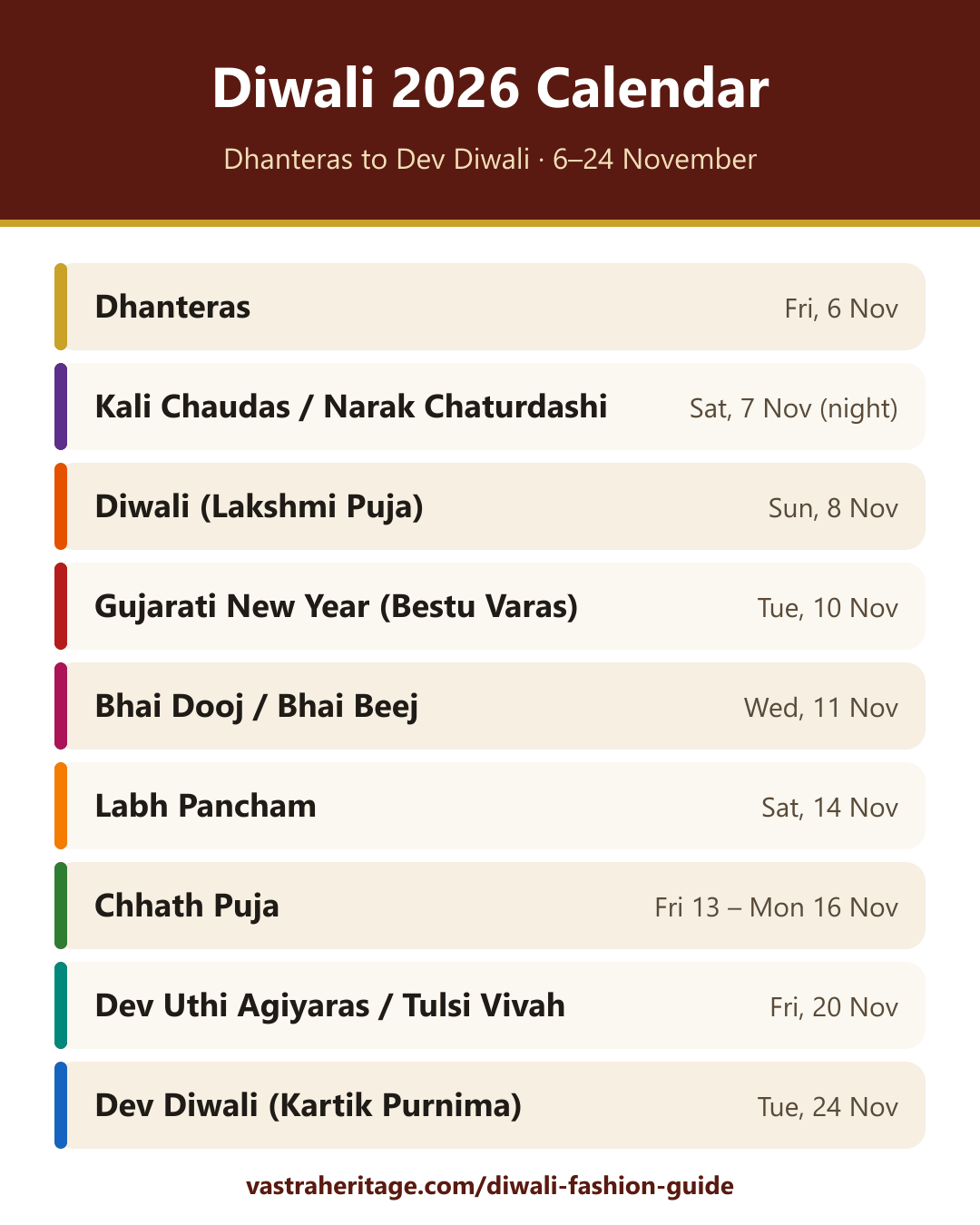
| Fri, 6 Nov | Dhanteras |
| Sat, 7 Nov (night) | Kali Chaudas / Narak Chaturdashi |
| Sun, 8 Nov | Diwali (Lakshmi Puja) |
| Tue, 10 Nov | Gujarati New Year (Bestu Varas) |
| Wed, 11 Nov | Bhai Dooj / Bhai Beej |
| Sat, 14 Nov | Labh Pancham |
| Fri 13 – Mon 16 Nov | Chhath Puja |
| Fri, 20 Nov | Dev Uthi Agiyaras / Tulsi Vivah (you are here) |
| Tue, 24 Nov | Dev Diwali (Kartik Purnima) |
Dates are for India; check your local panchang, as some festivals shift by a day in other cities and abroad.
Frequently asked questions
When is Dev Uthani Ekadashi in 2026?
Dev Uthani Ekadashi is on Friday, 20 November 2026 for most households (Smarta tradition). Some Vaishnava communities observe it on Saturday, 21 November.
When is Tulsi Vivah in 2026?
Many families celebrate Tulsi Vivah on Saturday, 21 November 2026 (Dwadashi), while others perform it on the Ekadashi evening, 20 November. Follow your family tradition or local panchang.
What is Dev Uthi Agiyaras?
Dev Uthi Agiyaras is the Gujarati name for Dev Uthani Ekadashi, the day Lord Vishnu wakes from his four-month sleep and the wedding season begins.
Why do weddings start after Dev Uthani Ekadashi?
During Chaturmas, when Lord Vishnu is believed to be asleep, many families avoid weddings. Once he wakes on Dev Uthani Ekadashi, auspicious ceremonies resume.
What is eaten during the Dev Uthani Ekadashi fast?
Fruits, milk, dry fruits and phalahar dishes like sabudana khichdi, singhara or rajgira flour dishes, and potatoes cooked with rock salt. Grains, pulses, onion and garlic are avoided.
How is Tulsi Vivah performed?
The tulsi plant is dressed as a bride, a sugarcane mandap is made, and Lord Vishnu as Shaligram or Krishna is married to her with wedding rituals, pheras, kanyadaan, songs and sweets.
What should women wear for Tulsi Vivah?
Many women dress as for a family wedding: a red, maroon or green silk saree, a Bandhani or Gharchola, or a light lehenga, with traditional jewellery.
What is Kartiki Ekadashi in Pandharpur?
In Maharashtra, Dev Uthani Ekadashi is called Kartiki Ekadashi, one of the two biggest pilgrimages to the Vitthal temple in Pandharpur.
What is Prabodhini Ekadashi?
Prabodhini Ekadashi is another name for Dev Uthani Ekadashi, meaning the Ekadashi of awakening.
When is the wedding season in 2026–27?
Weddings resume after Dev Uthani Ekadashi in late November and continue until about mid-December. Many families pause during Kharmas (mid-December to mid-January) and resume from mid-January. Fix exact dates with a priest or panchang.
What comes after Dev Uthani Ekadashi?
Dev Diwali on Kartik Purnima, Tuesday 24 November 2026, which closes the Diwali season.