Chhath Puja 2026 is celebrated over four days, from Friday, 13 November to Monday, 16 November. Devotees worship Surya, the Sun god, and Chhathi Maiya with a demanding fast, offering arghya to the setting sun on Sunday, 15 November and to the rising sun on Monday, 16 November, standing in rivers and ponds.
Chhath is the great festival of Bihar, Jharkhand, eastern Uttar Pradesh and the Madhesh region of Nepal, and today it is celebrated wherever people from these regions live, from Delhi and Mumbai to Dubai and the US. It is known for its discipline and purity: no idols, no priests required, just the devotee, the water and the sun.
Quick answers:
- Day 1, Nahay Khay: Friday, 13 November 2026.
- Day 2, Kharna: Saturday, 14 November 2026; the 36-hour nirjala (waterless) fast begins after the evening prasad.
- Day 3, Sandhya Arghya: Sunday, 15 November 2026, offering to the setting sun.
- Day 4, Usha Arghya and parana: Monday, 16 November 2026, offering to the rising sun and ending the fast.
- Traditional saree colours: yellow, orange (kesariya) and red, usually in cotton or a light handloom silk.
Sunrise and sunset times differ by city, so take arghya timings from your local panchang or ghat committee.
Chhath Puja 2026: the four days at a glance
| Date | Day | What happens |
|---|---|---|
| Fri, 13 Nov | Nahay Khay | Holy bath, cleaning the home; one sattvik meal of kaddu-bhaat (bottle gourd, chana dal and rice) cooked in ghee |
| Sat, 14 Nov | Kharna | Day-long fast; in the evening, gur ki kheer (jaggery rice pudding) and roti offered and eaten as prasad; then the 36-hour nirjala fast begins |
| Sun, 15 Nov | Sandhya Arghya | Families carry the prasad to the ghat; devotees stand in water and offer arghya to the setting sun |
| Mon, 16 Nov | Usha Arghya and parana | Arghya to the rising sun at dawn; prasad is shared and the fast is broken |
Why Chhath is celebrated
Chhath is one of the few Hindu festivals dedicated directly to the Sun, the visible source of life and energy, and to Chhathi Maiya, worshipped as a protector of children and families. Devotees pray for the health, long life and prosperity of their families, and for children.
Folk tradition links Chhath with several stories: Karna, the son of Surya in the Mahabharata, is said to have worshipped the Sun standing in water every day; Draupadi and the Pandavas are believed to have kept the vrat to regain their kingdom; and Sita is said to have performed the ritual after returning to Ayodhya, a story especially loved in Bihar. Whatever the story, the heart of Chhath is gratitude to the Sun.
The festival is also remarkable for its simplicity and equality: the whole community cleans the ghats together, devotees of every background stand side by side in the water, and the prasad is made at home from seasonal produce.
The rituals, day by day
Nahay Khay (Day 1)
The vratin (the person keeping the fast, often but not only a woman) bathes in a river or at home, the house is cleaned thoroughly, and a single pure meal of kaddu-bhaat is cooked, usually without onion and garlic, and eaten after offering it to the Sun.
Kharna (Day 2)
The vratin fasts through the day. In the evening, gur ki kheer and roti are prepared, often on a clay stove with mango wood, offered and eaten. Family and neighbours come to receive the prasad. After this meal, the 36-hour fast without water begins.
Sandhya Arghya (Day 3)
The family carries the prasad to the ghat in a bamboo basket (daura) and winnowing baskets (soop) filled with thekua, fruits, sugarcane, coconut and lamps. At sunset, the vratin stands in the water and offers arghya with milk and water while the family sings Chhath songs. Many families keep lamps lit through the night (kosi bharna, in some homes).
Usha Arghya and parana (Day 4)
Before dawn the family returns to the ghat. As the sun rises, the vratin offers the final arghya, receives blessings, shares prasad with everyone, and breaks the fast with water, ginger and prasad.
Chhath prasad: thekua and the soop
The prasad is prepared with great care for purity, often in a freshly cleaned kitchen with new utensils.
- Thekua: the signature Chhath sweet, made from wheat flour, jaggery and ghee, shaped with a wooden mould and fried until crisp.
- Kasar or laddu of rice flour and jaggery.
- Seasonal fruits and produce: banana, sugarcane, coconut, citrus (such as the large local lemon), radish, sweet potato, water chestnut, turmeric and ginger plants.
- The soop and daura: bamboo winnowing baskets and a carrying basket that hold the offerings to the ghat.
Simple thekua recipe
Melt jaggery in a little water and cool slightly. Mix with whole-wheat flour, a few spoons of ghee, grated dry coconut and fennel seeds to a firm dough. Press portions into a thekua mould or flatten with a fork pattern, and fry on low heat until golden and crisp.
The Chhath saree guide: colours, fabrics and draping
For the women keeping the vrat, and for the family around them, what to wear for Chhath is a meaningful choice. Many vratins wear a new, unstitched saree for the arghya, as unstitched cloth is considered pure, and families often gift the vratin a new saree for the festival.
Colours
| Colour | Why it is chosen |
|---|---|
| Yellow (pila) | The most traditional Chhath colour, linked with the Sun and purity |
| Orange / kesariya | The colour of the rising and setting sun; very popular for arghya |
| Red and maroon | Auspicious for married women |
| Pink and green | Common for family members and younger women |
Black and very dark colours are generally avoided.
Best fabrics
- Cotton handloom: light, breathable and dries faster after standing in water; ideal for the vratin.
- Bhagalpuri tussar silk: Bihar's own wild silk from Bhagalpur, with a soft golden sheen; lovely for family members and for the evening arghya.
- Madhubani-printed or hand-painted sarees: Mithila art on cotton or tussar, a beautiful regional choice.
- Bengal tant and cotton-silk: crisp, easy to manage on crowded ghats.
Avoid heavy silk and heavily embroidered sarees for standing in water; they become very heavy when wet and are hard to dry. Read more about wild silks in our East India textiles guide and about everyday handlooms in our types of sarees guide.
Draping for standing in water
- Drape the saree slightly higher above the ankle so the pleats stay out of the mud.
- Pin the pleats firmly and tuck the pallu securely; you will need both hands for the soop.
- Carry a dry change of clothes in the family bag for after the arghya.
Sindoor, jewellery and finishing touches
A distinctive custom of Chhath is the long orange sindoor applied from the nose to the parting of the hair (naak se maang tak), a symbol of a married woman's blessings for her husband's long life. Jewellery is usually simple: a nose ring, bangles and toe rings. Many vratins avoid heavy jewellery for the rituals in water.
What the family wears
| Who | Outfit idea |
|---|---|
| Vratin (fasting woman) | A new unstitched cotton saree in yellow, orange or red |
| Women in the family | A Bhagalpuri tussar, Madhubani or cotton-silk saree, or a suit in festive colours |
| Men | A dhoti and kurta, or a kurta-pyjama; male vratins often wear an unstitched dhoti |
| Girls | A cotton lehenga, a simple suit or a frock in yellow or pink |
| Everyone at dawn | A shawl or light jacket; mid-November mornings by the water are cold |
Ghat safety and practical tips
- Reach early and choose a spot with firm steps; follow barricades and the ghat committee's directions.
- Keep children close, with a name and phone number in their pocket.
- Carry a torch, a dry towel, a change of clothes, a shawl and drinking water for family members who are not fasting.
- Use eco-friendly offerings: leaf plates and clay lamps rather than plastic; keep the river clean.
- Look after the vratin: after a 36-hour waterless fast, they need rest and help on the steps.
The songs of Chhath
Chhath is unimaginable without its folk songs, sung in Bhojpuri, Maithili and Magahi by women walking to the ghat and waiting in the water. Songs such as "Kaanch hi baans ke bahangiya" and "Ugi hai suruj dev" describe the bamboo baskets, the river and the rising sun. The late folk singer Sharda Sinha's recordings are played at ghats everywhere, and many families sing the same songs their grandmothers sang.
Gift ideas for the vratin
- A new cotton or Bhagalpuri tussar saree in yellow, orange or red.
- A brass or bamboo soop and daura for next year's puja.
- A warm shawl for the dawn arghya.
- A pair of sindoor boxes or bangles.
Chhath away from Bihar
Families who cannot travel home celebrate at community ghats set up by Purvanchali groups in Delhi, Mumbai, Kolkata, Surat, Bengaluru and other cities, and on beaches and lakes abroad. Many also create a small water tank on the terrace for the arghya. The rituals and songs are the same; only the river changes.
Diwali season 2026 calendar
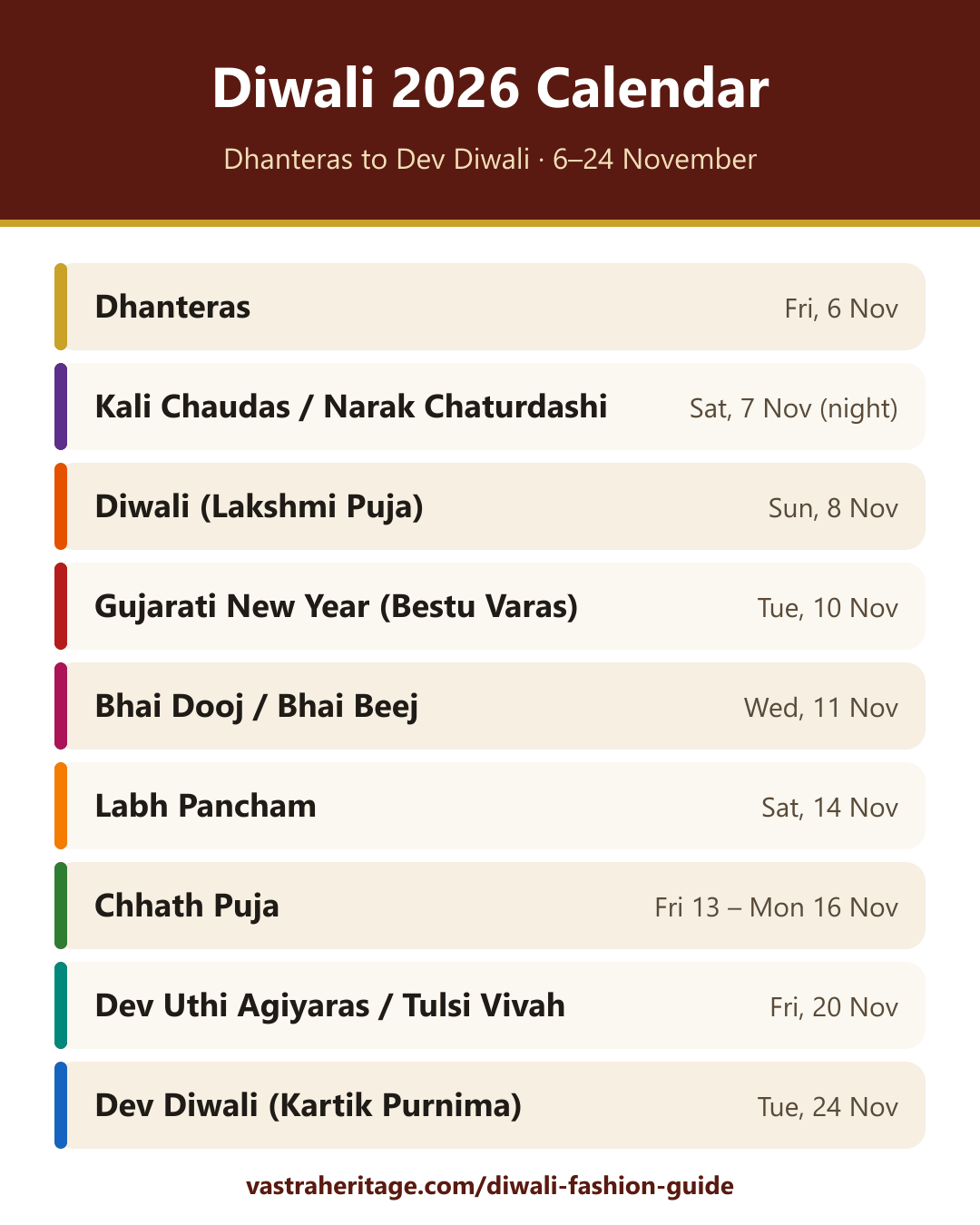
| Fri, 6 Nov | Dhanteras |
| Sat, 7 Nov (night) | Kali Chaudas / Narak Chaturdashi |
| Sun, 8 Nov | Diwali (Lakshmi Puja) |
| Tue, 10 Nov | Gujarati New Year (Bestu Varas) |
| Wed, 11 Nov | Bhai Dooj / Bhai Beej |
| Sat, 14 Nov | Labh Pancham |
| Fri 13 – Mon 16 Nov | Chhath Puja (you are here) |
| Fri, 20 Nov | Dev Uthi Agiyaras / Tulsi Vivah |
| Tue, 24 Nov | Dev Diwali (Kartik Purnima) |
Dates are for India; check your local panchang, as some festivals shift by a day in other cities and abroad.
Frequently asked questions
When is Chhath Puja in 2026?
Chhath Puja 2026 runs from Friday, 13 November (Nahay Khay) to Monday, 16 November (Usha Arghya). Sandhya Arghya is on Sunday, 15 November.
What are the four days of Chhath Puja?
Nahay Khay (holy bath and a pure meal), Kharna (fast, then evening kheer prasad), Sandhya Arghya (offering to the setting sun) and Usha Arghya (offering to the rising sun and ending the fast).
Which colour saree is best for Chhath Puja?
Yellow, orange (kesariya) and red are the most traditional colours for Chhath. Pink and green are also common for family members. Black is generally avoided.
Which fabric is best for a Chhath saree?
Cotton handloom is best for the vratin because it is light and dries quickly after standing in water. Bhagalpuri tussar silk, Madhubani-printed and cotton-silk sarees suit family members.
Why do vratins wear unstitched sarees on Chhath?
Unstitched cloth is considered pure for rituals, so many vratins wear a new unstitched saree, and male vratins an unstitched dhoti, for the arghya.
What is Kharna?
Kharna is the second day of Chhath. The vratin fasts all day and in the evening offers and eats gur ki kheer and roti as prasad, after which the 36-hour waterless fast begins.
What is thekua?
Thekua is the signature Chhath prasad, a crisp sweet made from wheat flour, jaggery and ghee, shaped with a wooden mould and fried.
Why is sindoor applied from the nose on Chhath?
The long orange sindoor from the nose to the hair parting is a traditional custom for married women on Chhath, a prayer for the husband's long life and the family's well-being.
Can men keep the Chhath vrat?
Yes. While many vratins are women, men also keep the Chhath fast, usually wearing an unstitched dhoti for the rituals.
What is offered to the Sun on Chhath?
Arghya of water and milk, along with a soop holding thekua, fruits, sugarcane, coconut, lamps and seasonal produce.
How can I celebrate Chhath outside Bihar?
Join a community ghat organised by Purvanchali groups in your city, or make a small water tank on your terrace for the arghya. The rituals, songs and prasad stay the same.