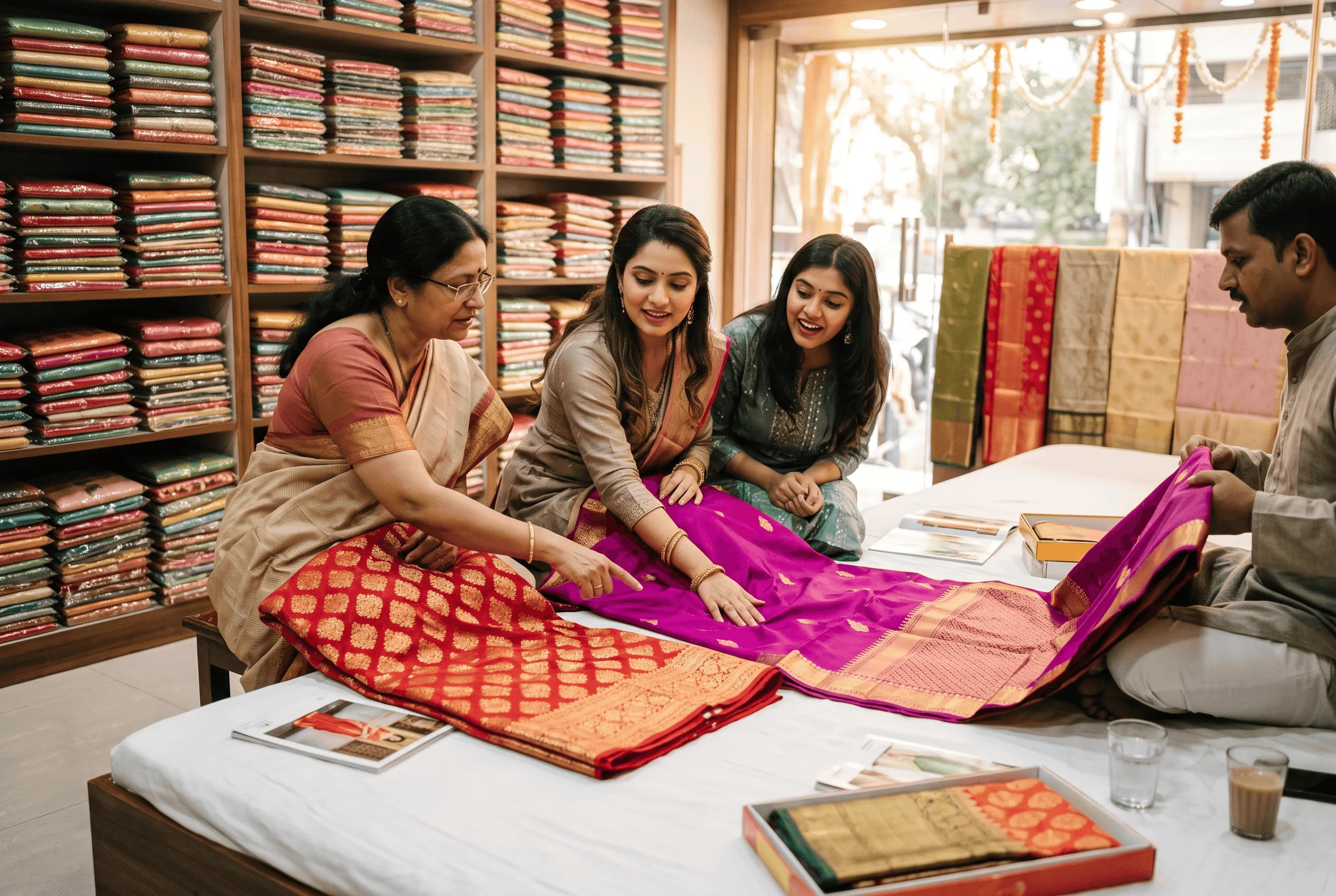
You are standing at a saree counter, a beautiful silk saree is spread in front of you and the seller says it is pure silk.
How do you know?
Most of the famous home tests, such as burning a thread or pouring bleach on a sample, are not practical in a shop, and you certainly cannot do them on a saree you have not bought.
This guide gives you a quick, practical checklist to identify a pure silk saree in about five minutes, using only your eyes, hands and a few smart questions.
It also explains which "tests" are unreliable, when to ask for certification, how price can be a warning sign and what to do at home after you buy.
For the full science and every detailed test, read our pillar guide on how to identify pure silk. This article is your shop-floor companion.
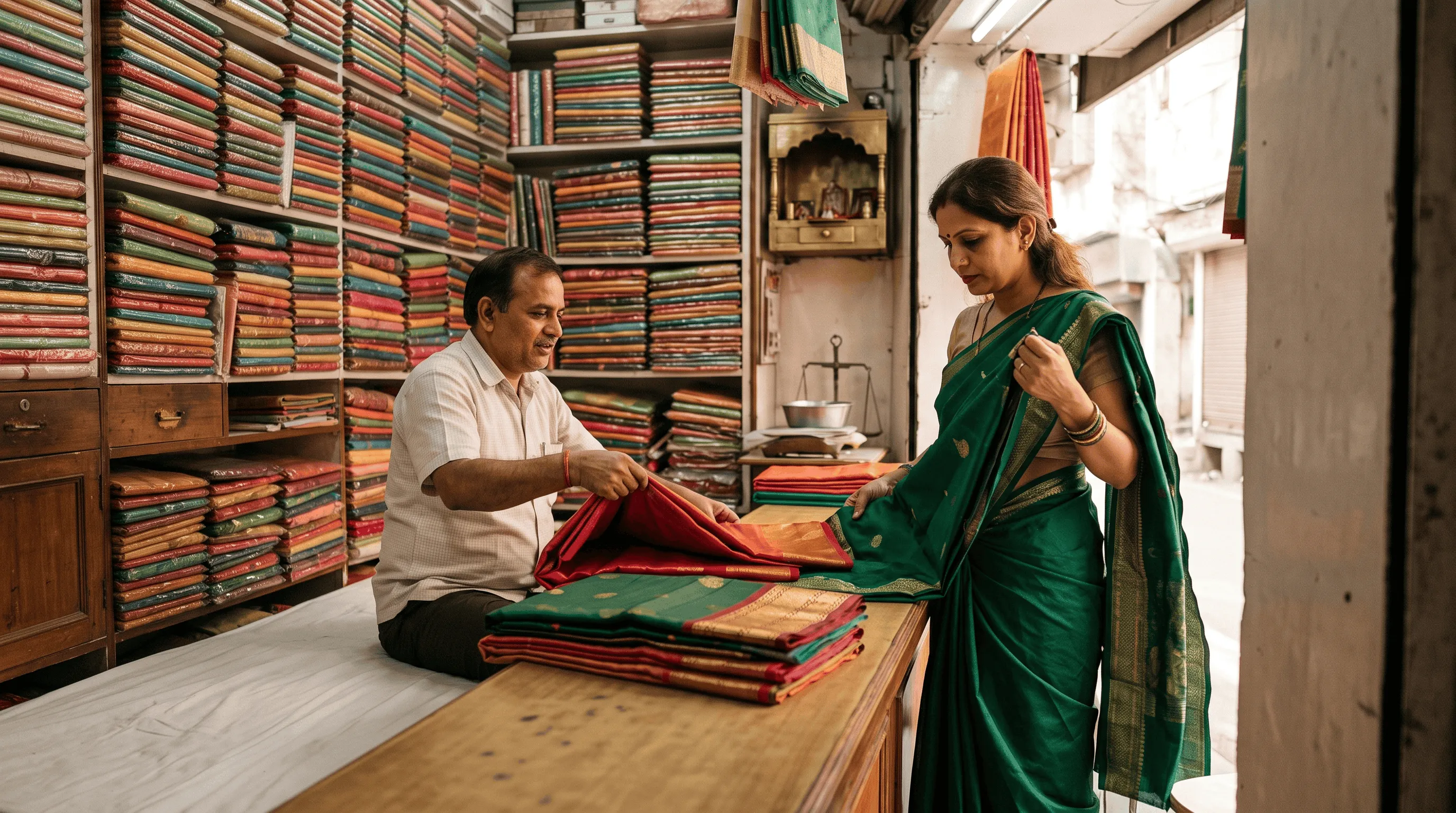
Before You Start: Set Your Expectations
Pure silk sarees are not cheap. A genuine handloom silk saree with zari usually costs several thousand rupees, and heavier bridal pieces cost much more.
If a seller offers a "pure Kanjivaram" or "pure Banarasi" at a price that seems too good to be true, treat it as your first warning sign.
It also helps to know what you are looking for: mulberry silk, tussar, muga or eri, and which weave. See our silk fabric types guide.
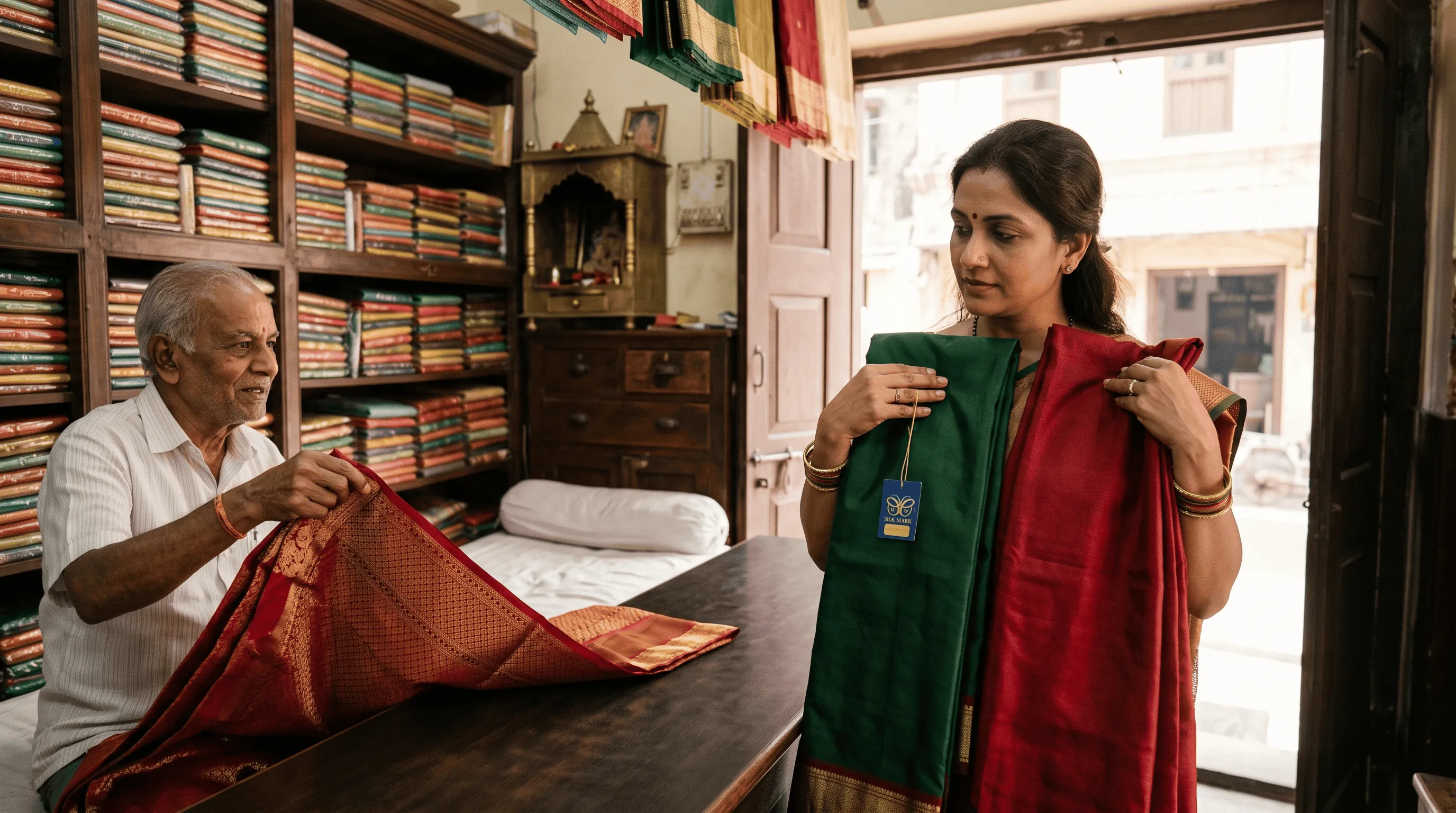
Minute 1: Look for the Silk Mark
The Silk Mark is a quality label for pure silk products in India.
Ask the seller whether the saree carries a Silk Mark tag or label.
A genuine Silk Mark label adds confidence that the fabric is pure silk, although you should still check the weave and zari for value.
If there is no Silk Mark, it does not automatically mean the saree is fake, especially from small weavers, but you should look more closely at the other checks.
Minute 2: Feel the Fabric
Warmth: pure silk usually feels slightly warm in your hand, while many synthetics feel cool and slippery.
Smoothness: pure mulberry silk feels smooth and soft, not plasticky.
Texture: tussar and raw silk have natural texture and slubs, which are normal.
Crumple test: gently crumple a corner for a few seconds. Pure silk usually creases softly, while polyester often springs back almost completely.
Ask permission before handling a saree roughly; a gentle crumple is enough.
Minute 3: Look at the Sheen in Daylight
Take the saree, or a corner of it, to natural light near the shop entrance.
Pure silk has a soft, multi-dimensional sheen that seems to change colour slightly as you move it.
Synthetic fabrics often have a flat, uniform, glassy or overly bright shine.
Shop lights can make almost any fabric look rich, so daylight is important.
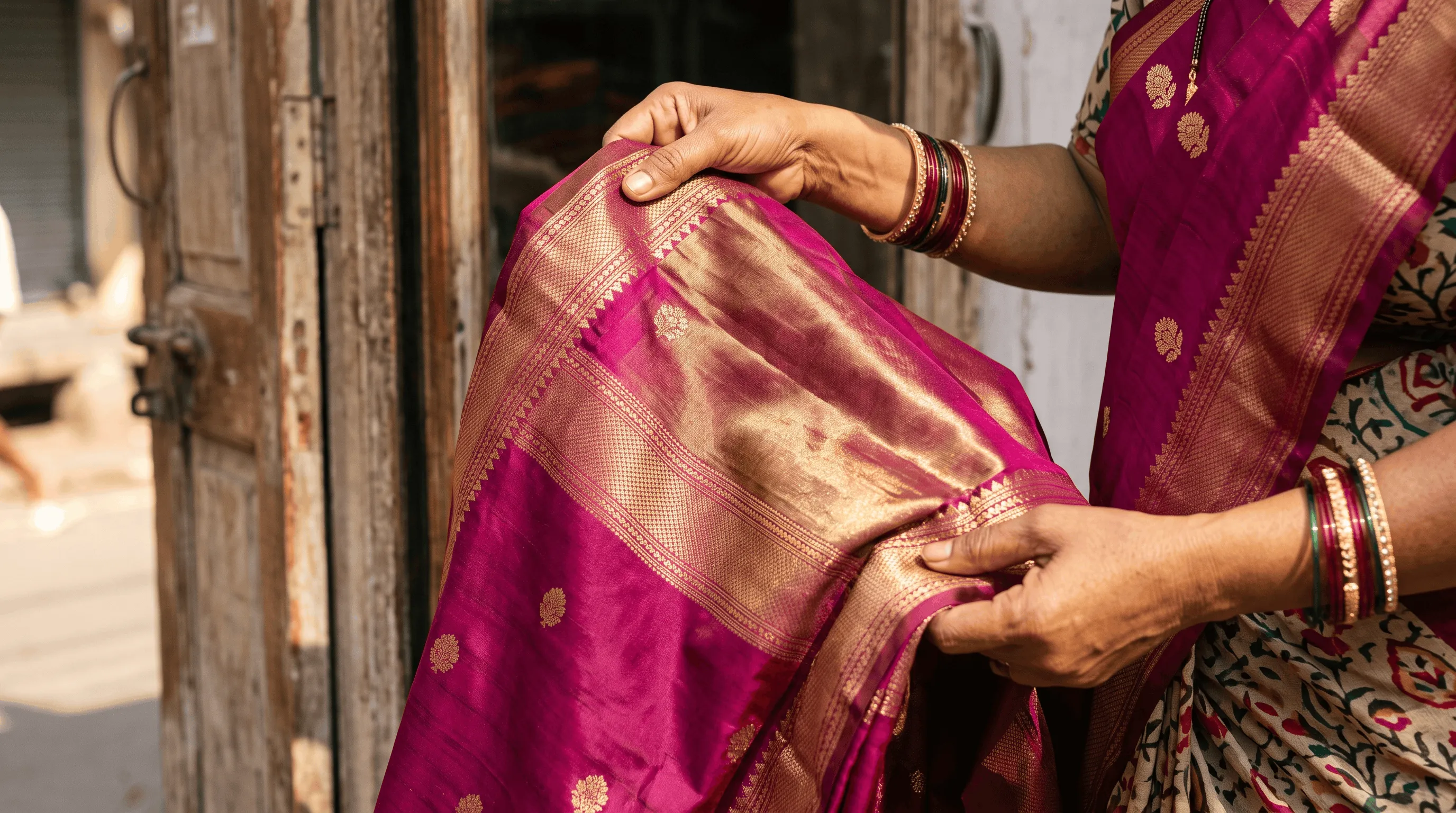
Minute 4: Turn It Over
The back of a saree tells you a lot.
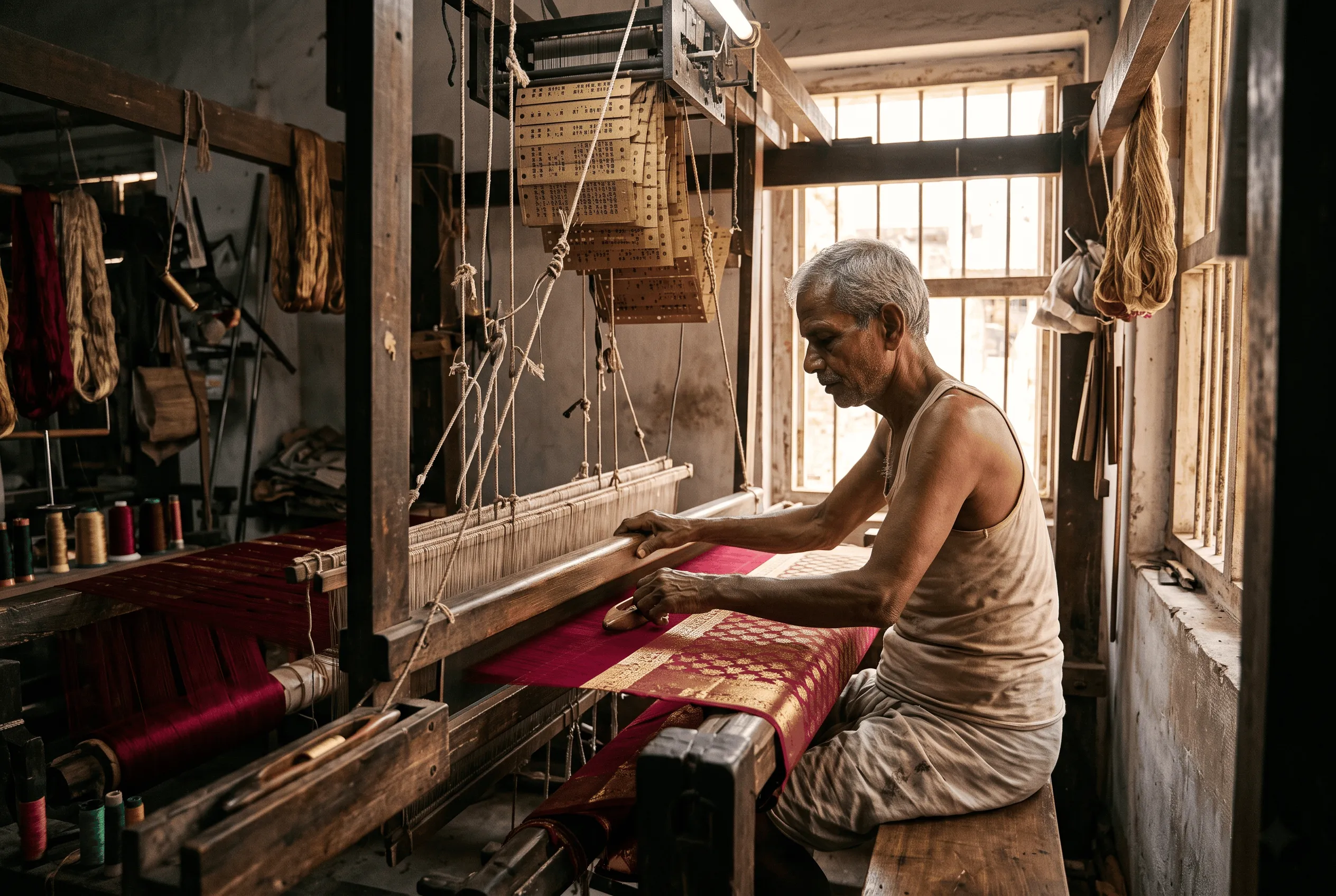
Handloom silk often shows small irregularities, neatly managed threads and slightly uneven selvedges.
Powerloom imitations may show long loose floats cut by machine on the reverse of brocades.
Borders: in handwoven sarees, borders are woven into the fabric. In Kanjivaram, look for the korvai join where the border interlocks with the body.
Zari: look at the zari from the back. Ask whether it is pure, tested or imitation zari.
See our guides on handloom vs powerloom sarees and zari silk.
Minute 5: Ask the Right Questions
Is this pure silk? Which silk is it?
Does it carry the Silk Mark?
Is it handloom or powerloom?
Is the zari pure, tested or imitation?
Where was it woven?
What is the return or exchange policy if it turns out not to be pure silk?
A genuine seller will answer confidently and clearly. Hesitation, vague answers or pressure to buy quickly are warning signs.
Tests That Are Not Reliable in a Shop
The ring test: pulling a saree through a finger ring is often recommended, but fine synthetics can pass through too, and heavy pure silks may not. It is not reliable on its own.
Rubbing for static or heat: results vary and are easy to misread.
"It feels heavy, so it must be silk": weight depends on zari, weave and fibre; synthetics can be heavy too.
Shine alone: synthetic fabrics can be very shiny.
Use these only as minor clues, not proof.
The Burn Test: Only at Home, Only on a Loose Thread
The burn test is one of the most reliable home tests, but never ask to burn a saree in a shop.
After buying, pull a loose thread from an inside seam or the end of the blouse piece and burn it carefully, away from anything flammable.
Pure silk burns slowly, smells like burning hair and leaves a soft, crushable black ash.
Polyester and nylon melt, smell like plastic and leave hard beads.
Viscose (art silk) burns quickly, smells like paper and leaves little ash.
If the result does not match the seller's claim, use the return policy you confirmed earlier.
Price as a Clue
| Saree type | Typical pure silk price range |
|---|---|
| Light pure silk (Mysore, Chanderi silk, simple weaves) | ₹5,000 – ₹20,000 |
| Kanjivaram or Banarasi (simpler weaves) | ₹10,000 – ₹30,000 |
| Bridal Kanjivaram or Banarasi | ₹30,000 – ₹1,00,000+ |
These are indicative 2026 ranges and vary by city, weight and zari. A "pure silk" saree priced far below these ranges deserves extra scrutiny. See our saree price guide.
Weave-Specific Quick Checks
Kanjivaram: look for heavy, structured silk, a korvai border join and a contrasting pallu. See how to identify pure Kanjivaram silk.
Banarasi: check the brocade on the reverse and ask about kadhwa or fekwa weaving. See our Banarasi buying guide.
Paithani: turn the pallu over; handwoven tapestry looks almost the same on both sides. See our Paithani saree guide.
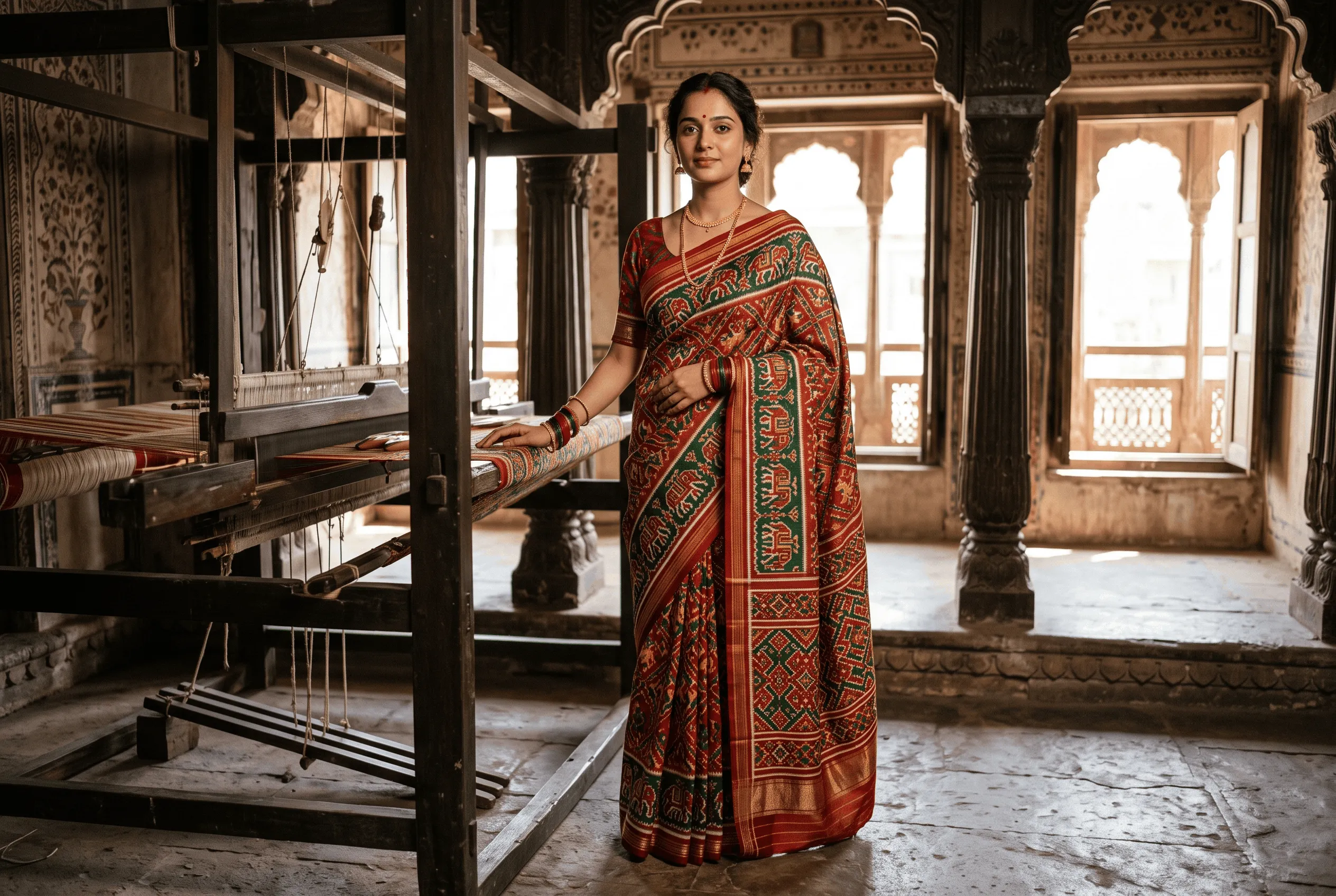
Patola: look for feathered ikat edges and, in double ikat, a near-identical reverse. See our Patola saree guide.
Tussar: expect natural texture and a golden-beige base. See our tussar silk guide.
Red Flags at the Counter
A price that is far below the usual range for the claimed weave.
No clear answers about fibre, weave or zari.
Refusal to provide a bill that mentions "pure silk".
No return or exchange policy.
Pressure to decide immediately.
Labels like "silk feel", "art silk" or "soft silk" presented as if they mean pure silk.
What "Art Silk" and "Soft Silk" Mean
Art silk (artificial silk) usually means viscose or polyester, not natural silk.
Soft silk is a term used in the market for some lighter silk or silk-blend sarees, and its meaning varies. Ask exactly what fibre it contains.
Silk blend contains silk mixed with another fibre.
There is nothing wrong with these fabrics if they are sold honestly and priced fairly.
Pure Silk vs Silk-Cotton
Silk-cotton sarees, such as many Chanderi and Maheshwari weaves, combine silk and cotton for a lighter, more breathable fabric.
They are genuine, beautiful handlooms in their own right, but they should not be sold as pure silk.
Silk-cotton usually has a softer, more matte sheen and a lighter feel than pure silk.
If you want silk-cotton, ask for it by name and pay a silk-cotton price; if you want pure silk, make sure the bill says so.
Get the Bill Right
Ask for a bill that clearly states "pure silk", the type of silk and, if relevant, the weave.
Keep the Silk Mark label and the bill together.
This protects you if you discover a problem later.
Buying Pure Silk Online
Look for detailed product descriptions with fibre content and weave.
Ask for daylight photographs of the front, back, border and zari.
Check for Silk Mark details and seller reputation.
Confirm the return policy before buying.
What to Do at Home After Buying
Do a careful burn test on a loose thread from the blouse piece or an inner seam.
Check the saree again in daylight.
Store it properly in muslin to protect your investment. See our silk saree care guide.
Common Mistakes Buyers Make
Trusting shop lighting is a common mistake.
Another is relying on the ring test alone.
Some buyers skip asking for a detailed bill and lose the ability to return a mislabelled saree.
Finally, avoid being rushed by sales pressure, especially for expensive purchases.
Buy Pure Silk With Confidence
Identifying a pure silk saree in a shop does not require special equipment.
Look for the Silk Mark, feel the fabric, check the sheen in daylight, turn the saree over and ask clear questions. Then confirm at home with a careful burn test on a loose thread.
With this five-minute checklist, you can shop confidently and pay a fair price for genuine silk.
For the complete guide, visit our how to identify pure silk pillar page, and explore the season's styles in the traditional wear trends 2026 guide.
Shopping With Family
Many silk sarees are bought for weddings with family members helping to choose.
Agree on a budget and a shortlist of weaves before you go, so the conversation focuses on quality rather than impulse.
Ask one person to handle questions about fibre, weave and zari while others focus on colour and design.
Why This Matters
Pure silk is an investment in craftsmanship, comfort and heritage.
Knowing how to identify it protects your money and supports honest sellers and genuine weavers who depend on fair prices for their work.


Comments (0)
Leave a Thought
No comments yet. Be the first to share your thoughts!