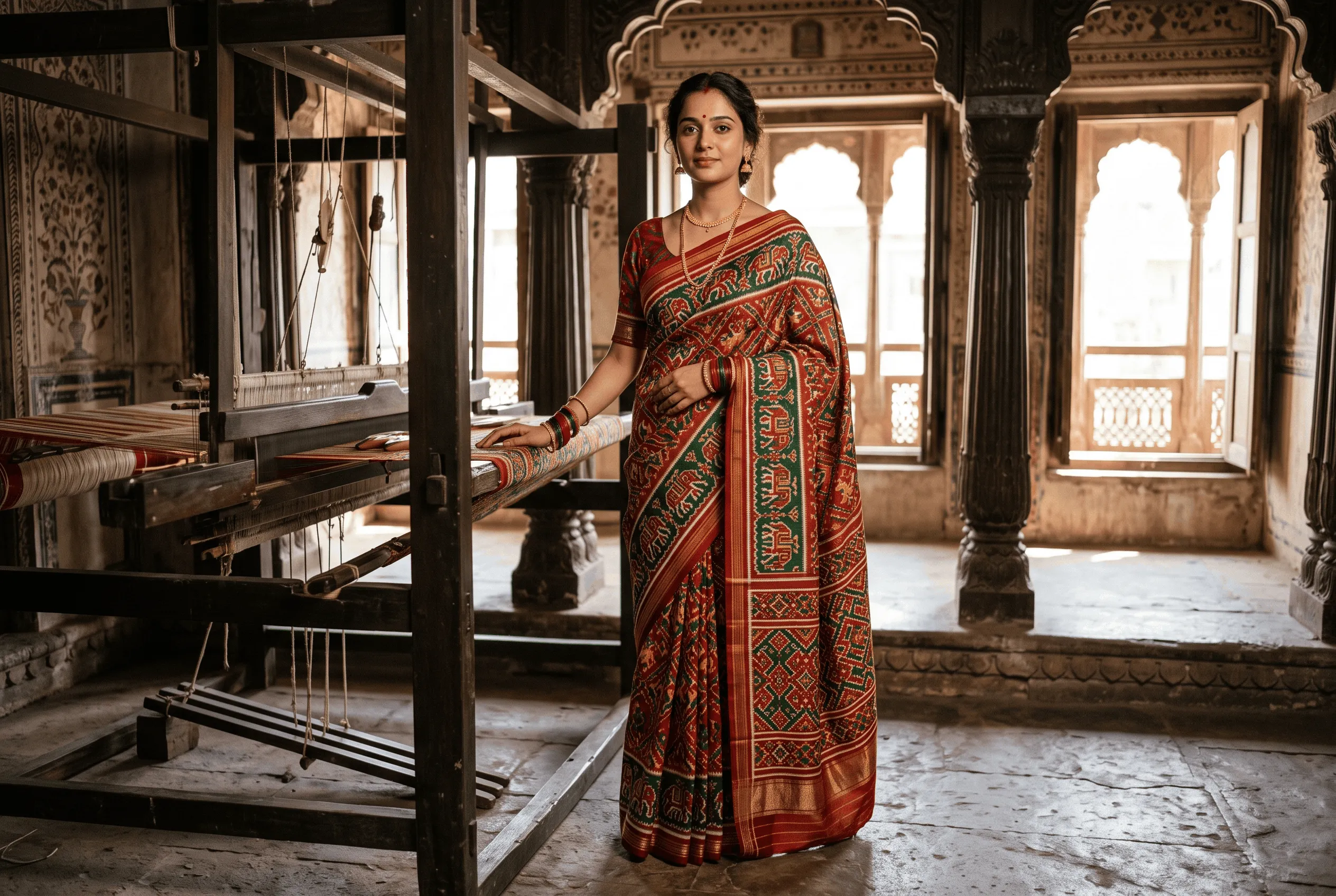
Patola is one of the rarest and most complex textiles in the world.
In a true Patan Patola, both the warp and the weft threads are tie-dyed before weaving, and the pattern only appears when every dyed thread meets its partner exactly on the loom. This technique, called double ikat, is so demanding that a single saree can take a team of weavers four to six months or more.
For centuries, Patola was treasured by royalty, traded across Asia and given as a precious wedding gift in Gujarat. Today, only a few families continue the authentic double ikat tradition in Patan.
This guide explains how Patola double ikat is made, its history, motifs and colours, how it differs from single ikat and printed copies, and how to style and care for a Patola saree. For a detailed buying comparison, see our guide to Patola sarees: Patan vs Rajkot, price and how to identify a real one.
What Is Ikat?
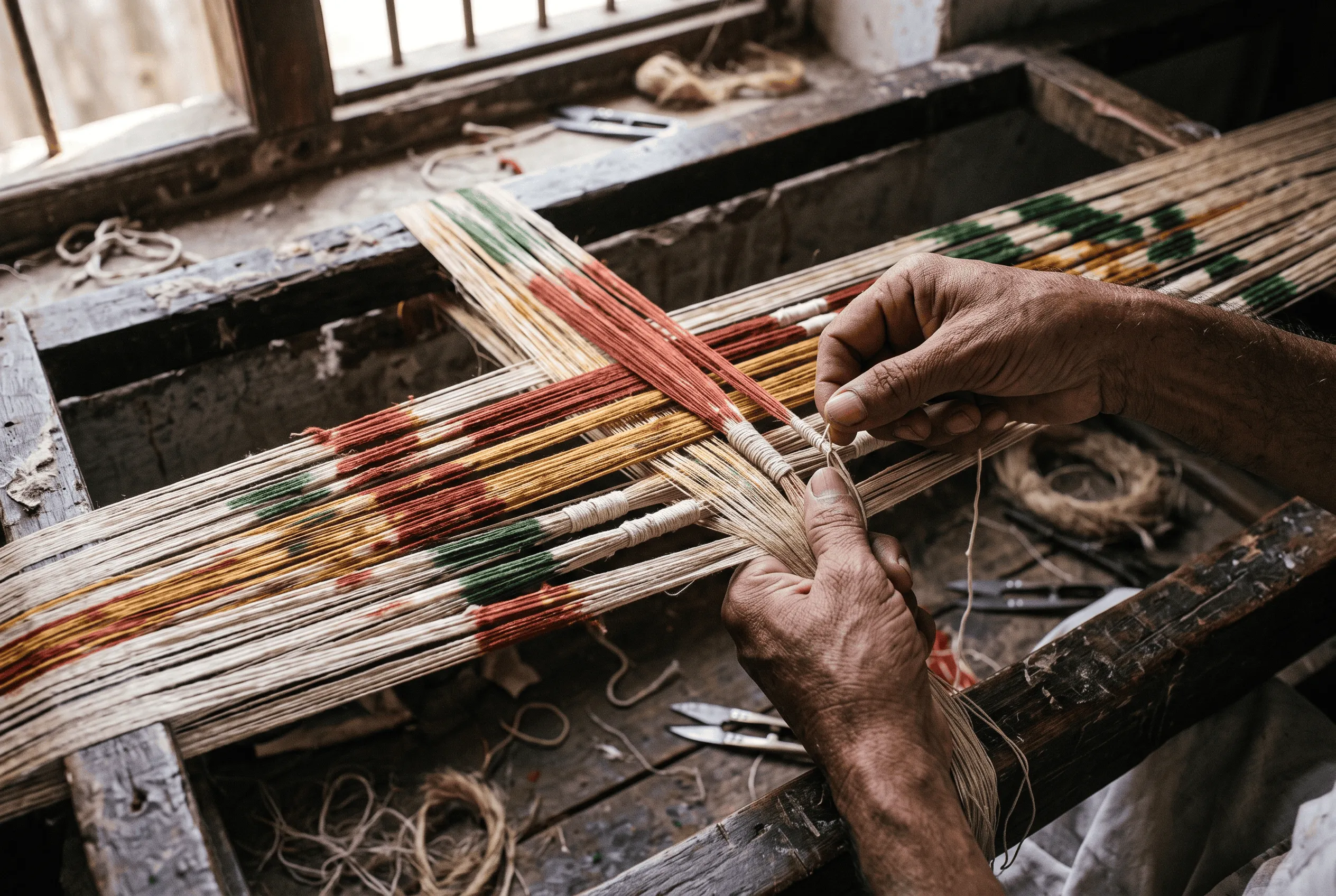
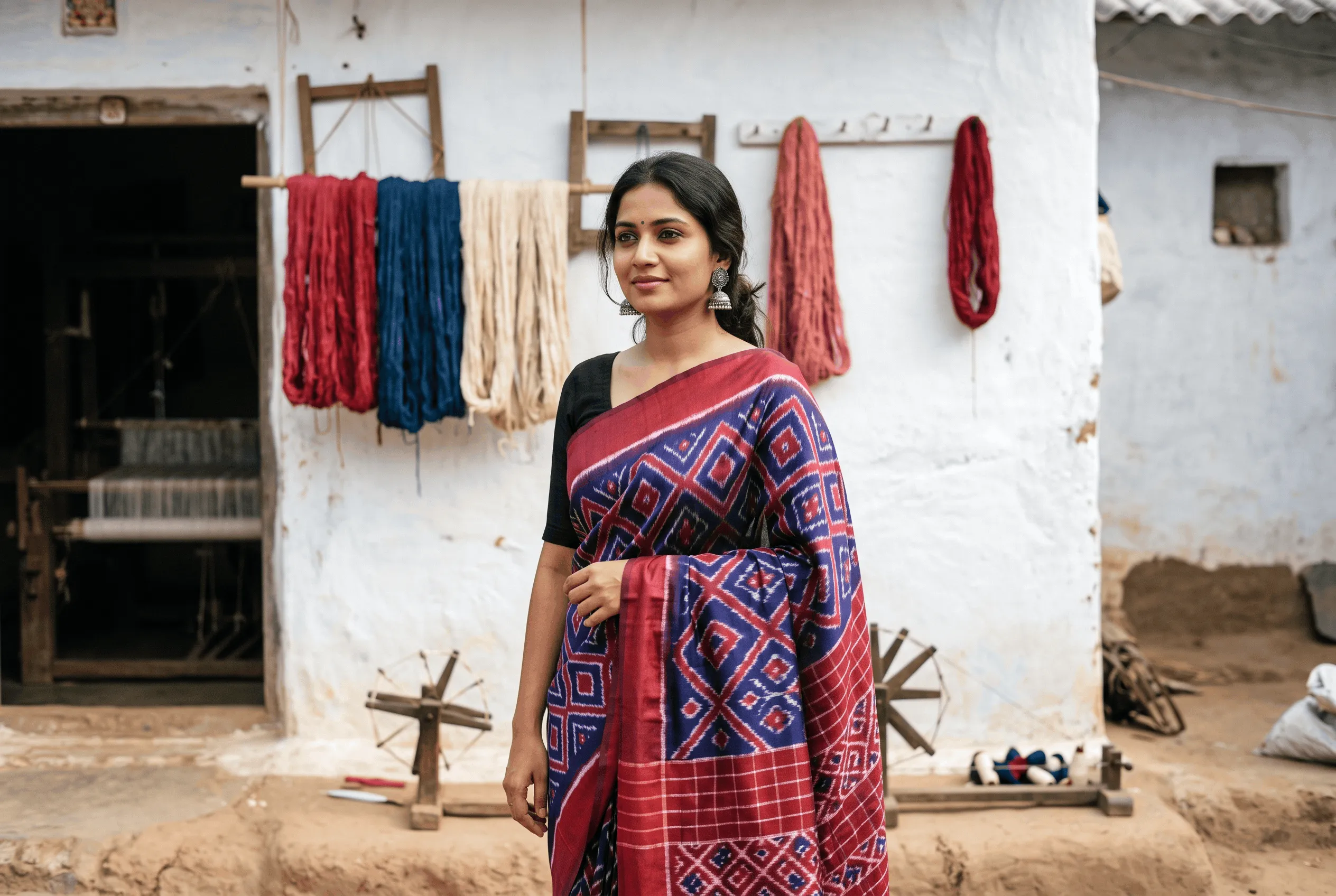
Ikat is a resist-dyeing technique in which threads are tied and dyed before weaving.
The tied sections resist the dye, and when the threads are woven, the dyed sections form the pattern.
Single ikat: only the warp or only the weft is tie-dyed.
Double ikat: both the warp and the weft are tie-dyed, and they must align perfectly to form the design.
Double ikat is woven in only a handful of places in the world, and Patan in Gujarat is the most famous in India.
How a Patan Patola Is Made
1. Planning the design
The weavers plan the design on graph paper, calculating exactly which sections of each warp and weft thread need which colour.
2. Tying the threads
Bundles of silk threads are stretched on a frame, and sections are tightly tied with cotton thread to resist the dye.
3. Dyeing in stages
The threads are dyed in stages, from the lightest colour to the darkest. After each dye bath, some ties are opened and new ones are added.
Traditionally, natural dyes were used; many weavers today use a mix of natural and fast synthetic dyes.
4. Aligning on the loom
Patan Patola is woven on a traditional tilted harness loom.
Every weft thread must be adjusted by hand so that its dyed sections meet the dyed sections of the warp exactly.
5. Weaving
Two weavers often work together on one loom, adjusting and aligning thread by thread.
A single saree can take four to six months or longer, depending on the design.
A Short History of Patola
Patola has been woven in Gujarat for centuries and is mentioned in historical records and literature.
Royal patronage: the Salvi weaving families are traditionally said to have come to Patan under royal patronage, and Patola became associated with Gujarat's rulers and nobility.
Global trade: Patola was exported to Southeast Asia, especially Indonesia, where it was treasured as a ceremonial and status textile and influenced local ikat traditions.
Wedding tradition: in Gujarat, a Patola saree has long been considered an auspicious gift for brides, and there is a famous Gujarati saying about the value of Patola's colours never fading.
Today, the craft survives through a small number of families in Patan, while single ikat Patola is also woven in Rajkot and other centres.
Patola Motifs
Patola designs are geometric, because they are built from the grid of the warp and weft.
Narikunj: a floral and geometric design traditionally associated with brides.
Paan bhat: a betel-leaf motif.
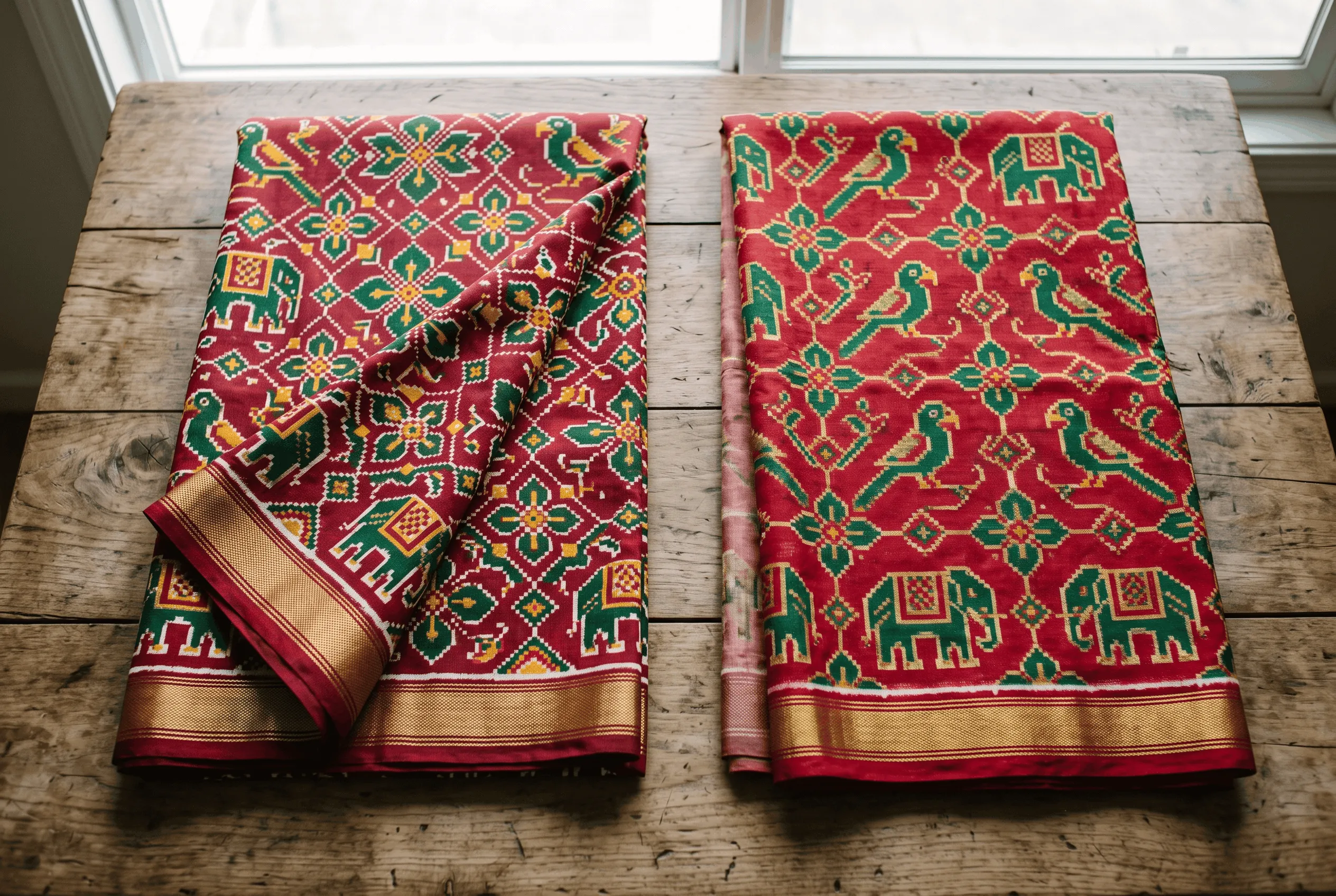
Nari kunjar bhat: women and elephants.
Chhabdi bhat: a basket motif.
Vohra gaji bhat: a design associated with the Vohra community.
Rattan chowk bhat: a jewel-square motif.
Fulvali bhat: flower motifs.
Popat kunjar: parrots and elephants.
Patola Colours
Traditional Patola colours are bold and deep: red, green, yellow, white and black, often with indigo.
Red and green Patolas are especially popular for weddings, while lighter and pastel colours are now made for modern wearers.
Patan Double Ikat vs Rajkot Single Ikat
| Feature | Patan Patola | Rajkot Patola |
|---|---|---|
| Technique | Double ikat (warp and weft) | Usually single ikat (weft) |
| Reverse side | Design identical on both sides | Design clearer on one side |
| Weaving time | Months | Weeks |
| Price | Very high | More accessible |
| Availability | Very limited | Wider |
Both are handwoven traditions, but Patan double ikat is far rarer and more expensive. Read our Patan vs Rajkot Patola guide for details.
How to Recognise Genuine Double Ikat
Both sides look the same: the pattern is fully visible and equally sharp on the reverse.
Slightly blurred edges: the "feathered" edges of the motifs come from tie-dyeing, not printing.
Perfect geometric alignment: motifs align across the whole saree.
Price and provenance: authentic Patan Patola is expensive and comes with clear origin details.
Printed copies have sharp edges, a faded reverse and much lower prices. See our authentic handloom red flags.
Styling a Patola Saree
For weddings
Red and green Patola with gold jewellery, a contrast silk blouse and a traditional drape.
Gujarati brides often wear a Patola for ceremonies, sometimes along with a gharchola or panetar.
For festivals
Patola is a beautiful choice for Navratri, Diwali and family pujas. See our Navratri chaniya choli trends for festive inspiration.
For modern events
Pair a Patola with a plain black or white blouse and minimal jewellery to let the pattern stand out.
Patola dupattas, stoles and jackets are also popular ways to wear the craft.
Drapes
Seedha pallu (Gujarati style): shows the pallu at the front. See North Indian saree draping styles.
Nivi drape: easy for receptions and modern events.
Jewellery for Patola
Gold and kundan: for weddings.
Silver and oxidised jewellery: for festive and casual looks.
Pearls: for a soft, elegant finish.
Keep jewellery simple, because Patola patterns are already bold.
Caring for Patola
Dry-clean only.
Store in muslin, away from sunlight.
Refold regularly to avoid creases.
Avoid perfume and moisture.
Patola colours are known for their durability when properly cared for. See our silk saree care guide.
The People Behind Patan Patola
Patan Patola has traditionally been woven by the Salvi community, with the knowledge passed down within families over generations.
Learning double ikat takes years. Apprentices start by learning to wind and tie threads, then dyeing, and only later the precise alignment on the loom.
Because only a few families continue the authentic Patan tradition, many Patolas are made to order, and buyers may have to wait months for a piece.
Patola Beyond Sarees
The craft is not limited to sarees.
Dupattas and stoles: smaller pieces bring Patola to more people and more occasions.
Handkerchiefs and small squares: traditional smaller items that show the same technique.
Fabric for blouses, jackets and kurtas: Rajkot single ikat fabric is especially popular for this.
Menswear: Patola stoles, Nehru jackets and ties for festive and wedding wear.
Framed pieces: some families frame a small Patola as a heritage artwork.
These are good ways to own a piece of Patola if a full saree is outside your budget.
Investing in a Patola
A Patan double ikat Patola is a serious purchase, and it is worth planning carefully.
Decide your budget first, including blouse fabric and safe storage.
Visit or contact the weaving families directly where possible, or buy from long-established sellers who can confirm the source.
Ask about the waiting time for made-to-order pieces, especially before a wedding.
Choose a timeless design and colour such as red-green narikunj or a classic paan bhat, which will stay meaningful for generations.
Keep all documentation of the origin and purchase, which matters for an heirloom textile.
If a Patan Patola is not practical, a well-made Rajkot single ikat from a trusted weaver is a beautiful and more affordable alternative.
Patola in Gujarati Weddings Today
Patola remains an important part of many Gujarati weddings.
Brides may wear a Patola for one of the ceremonies or receive one as a gift from family. Mothers and grandmothers often wear heirloom Patolas for the wedding rituals, and Patola dupattas are popular with modern brides who want to include the craft in a lehenga look.
Some couples coordinate the groom's stole or safa with the bride's Patola colours for a beautiful, connected look in wedding photographs.
Styling Patola With Modern Pieces
Patola is not only for traditional looks.
With a black or white blouse: the cleanest modern pairing, which lets the geometric pattern take centre stage.
With a belt: a slim metallic or leather belt over a Patola saree creates a structured, contemporary silhouette.
As a dupatta: a Patola dupatta over a plain silk kurta or a solid lehenga adds heritage to a modern outfit.
As a jacket: a Rajkot ikat jacket over a plain dress or kurta is easy to wear for festive lunches.
With minimal jewellery: a pair of statement earrings is often enough, because the pattern is already bold.
Why Patola Matters
Patola represents extraordinary skill, patience and mathematical precision.
Buying genuine Patola, or Rajkot single ikat from trusted weavers, supports the families keeping this rare craft alive.
Treasuring a Patola
A Patola saree is more than clothing. It is a piece of living heritage that can last for generations.
Whether you invest in a Patan double ikat or choose a Rajkot single ikat, learn the craft, buy from trusted sources and care for it well.
Explore more in our guides to West India textiles: Patola, Bandhani and Paithani, bandhani vs leheriya vs patola and on our West India page.
Comments (0)
Leave a Thought
No comments yet. Be the first to share your thoughts!