Kantha began as one of the most practical crafts imaginable.
Women in Bengal layered old, worn sarees and dhotis, stitched them together with simple running stitches using threads pulled from the sarees' own borders, and turned them into quilts, wraps and cloths for the home. Over time, those stitches became birds, fish, lotuses, scenes from village life and stories from mythology.
Today, Kantha is one of India's most loved hand embroideries, seen on tussar and silk sarees, dupattas, stoles, jackets, kurtas and bags. Its gentle rippled texture and hand-drawn charm make it perfect for contemporary ethnic wear.
This guide explains what Kantha is, its history and types, how it is used on modern sarees and outfits, how to style it, how to tell hand Kantha from machine copies, and how to care for it.
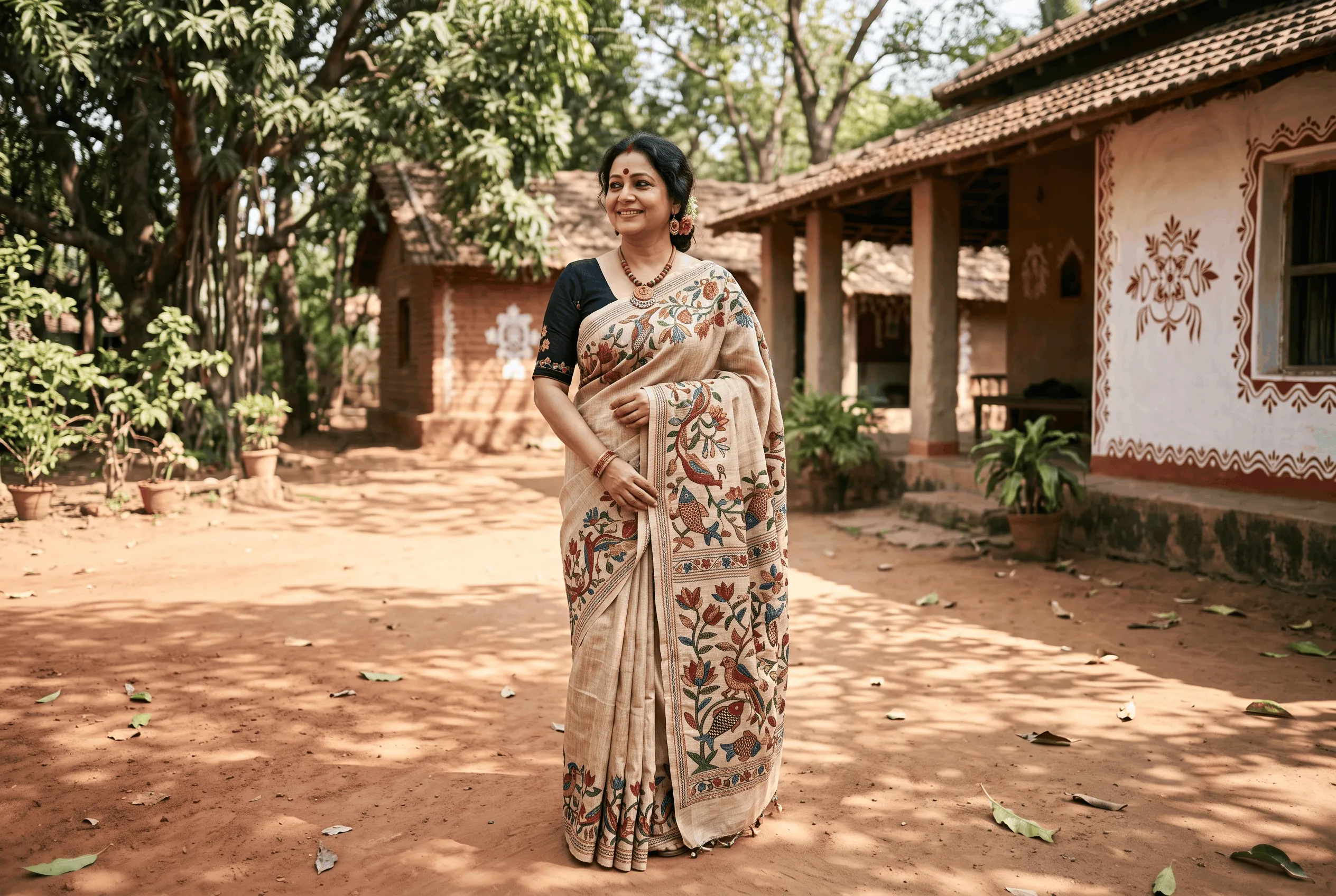
What Is Kantha?
Kantha is a hand embroidery from West Bengal, Bangladesh and parts of Odisha and Bihar.
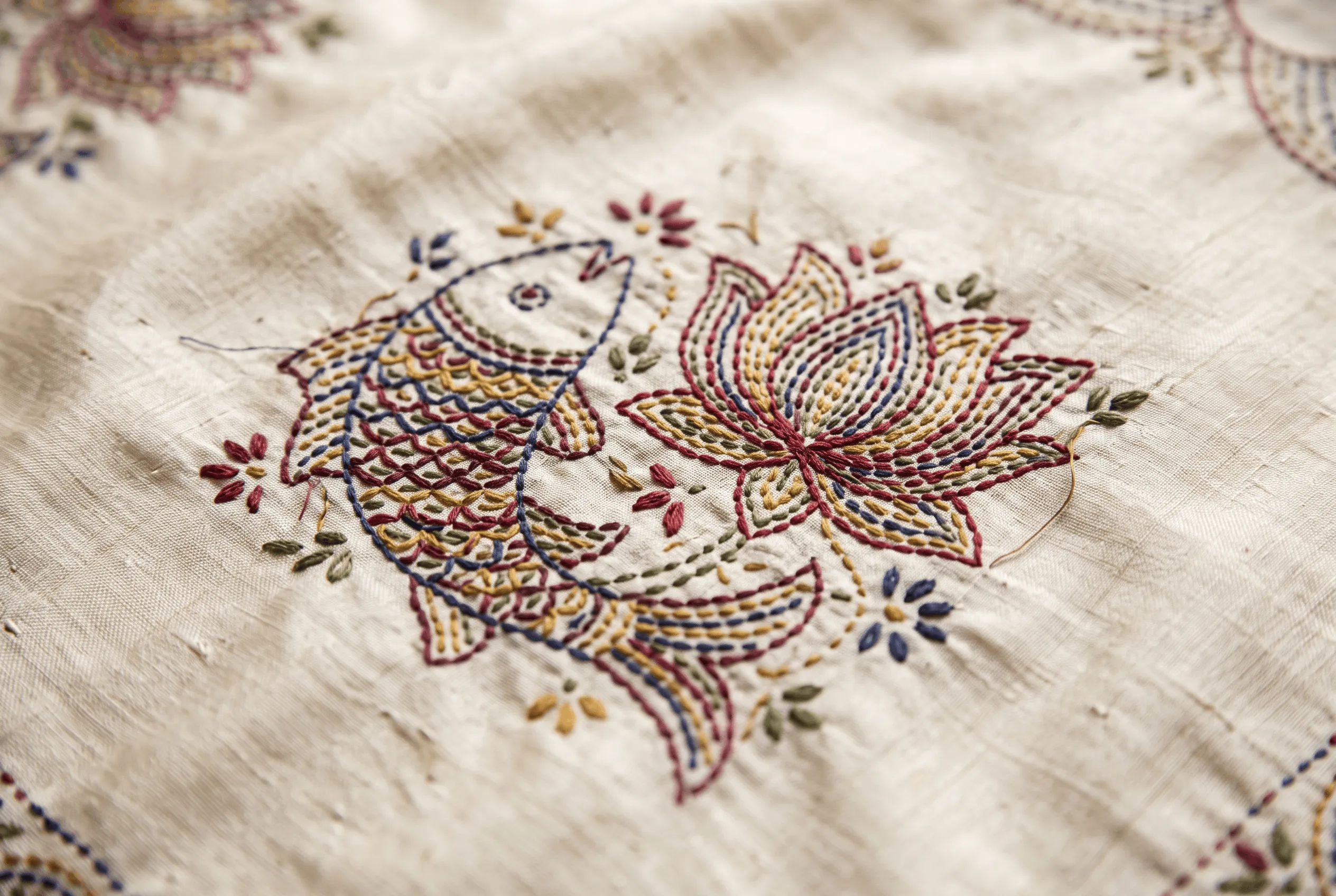
Its signature is the running stitch: small, even stitches that create lines, fill shapes and give the fabric a soft, rippled, quilted look.
The word "kantha" is used both for the stitch and for the layered, quilted cloths traditionally made with it.
A Short History
Kantha was traditionally made by women at home, often during the quiet afternoons of the monsoon.
Reuse: old sarees and dhotis were layered together, so nothing was wasted.
Threads from borders: coloured threads were often pulled from saree borders.
Personal stories: women stitched motifs that reflected their lives, beliefs and surroundings, and many kanthas were made as gifts for weddings and births.
Nakshi kantha: the most decorative form, with elaborate figurative designs, is especially celebrated in Bengal.
In the twentieth century, cooperatives and organisations helped turn Kantha into a source of livelihood for rural women, and designers brought it onto sarees and fashion.
Kantha Stitches and Techniques
Running stitch: the basic Kantha stitch, used for outlines and filling.
Filling stitches: dense rows of running stitches that fill motifs and create texture.
Lohori kantha: stitches that create wave-like or rippled patterns.
Darning-style variations: used to create geometric fills.
Back stitch and chain stitch: sometimes used for outlines.
Types of Traditional Kantha
Lep kantha: thick, padded quilts for winter.
Sujni kantha: spreads and covers for special occasions.
Baiton kantha: wraps for books and valuables.
Oaar kantha: pillow covers.
Rumal kantha: small square cloths.
Durjani or thalia: small purses and wallets.
Arshilata: covers for combs and mirrors.
Common Kantha Motifs
Lotus: a symbol of purity, often at the centre.
Fish: a symbol of fertility and abundance in Bengal.
Birds and peacocks: symbols of beauty and love.
Trees of life and creepers: symbols of growth.
Village scenes: people, boats, animals and festivals.
Mythological stories: episodes from the epics and folk tales.
Geometric borders: to frame the design.
Kantha in Contemporary Ethnic Wear
Kantha sarees
Tussar silk Kantha: the most popular combination, with Kantha's colourful stitches on tussar's natural golden-beige base. See our tussar silk guide.
Bangalore silk and other silk Kantha: smoother, more lustrous bases for festive wear.
Cotton Kantha: light and comfortable for daily and office wear.
Kantha on pallu and borders: lighter options with embroidery only in key areas.
All-over Kantha: heavily embroidered statement sarees.
Kantha dupattas and stoles
Silk or cotton dupattas with Kantha brighten plain kurtas and suits.
Kantha jackets and kurtas
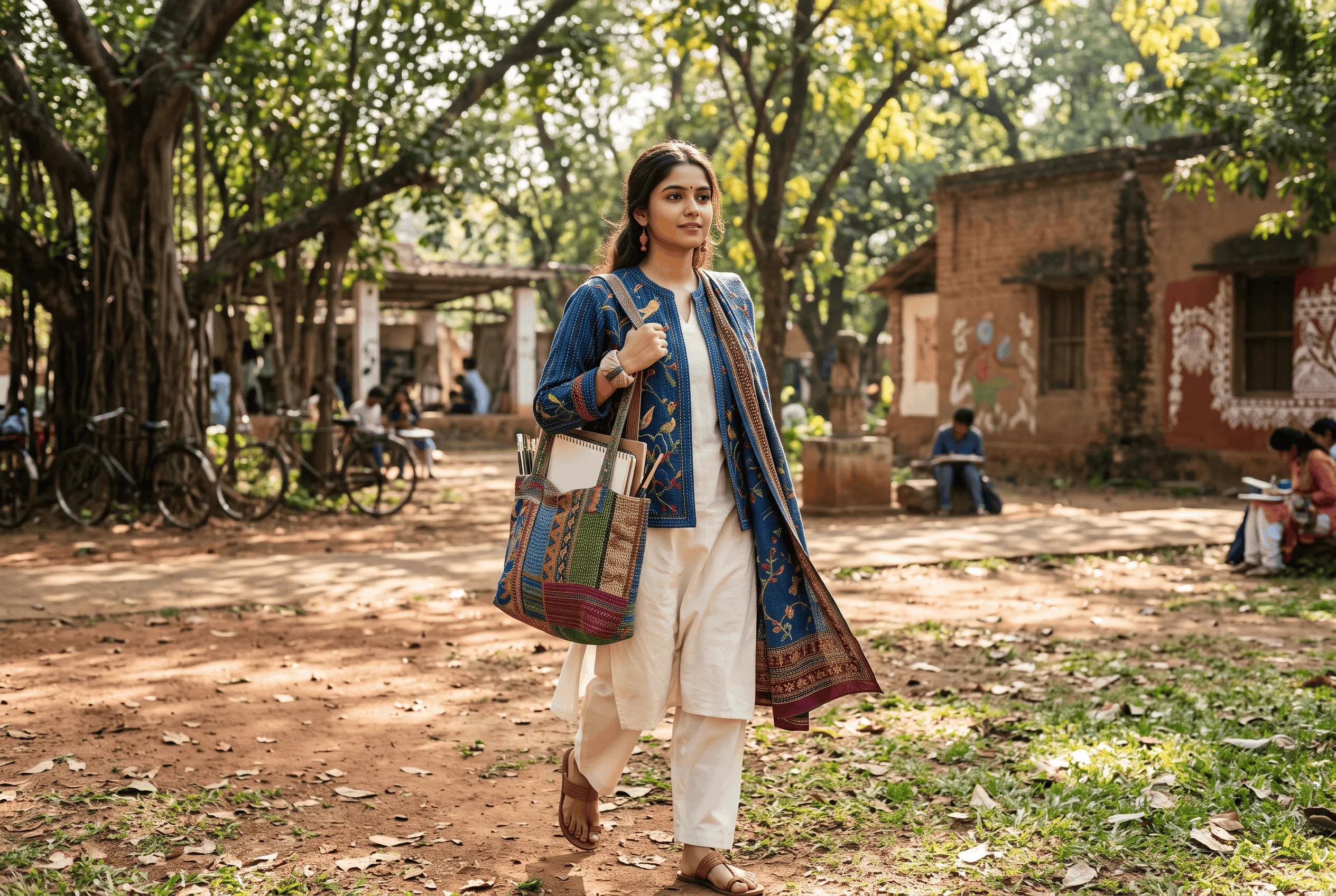
Kantha jackets over kurtas, dresses or jeans are a modern favourite, and Kantha kurtas are popular for festive and casual wear.
Men's wear
Kantha stoles, Nehru jackets and kurtas are popular choices for men.
Accessories
Kantha bags, clutches, cushion covers and quilts bring the craft into everyday life.
When to Wear Kantha
Office wear: cotton or light silk Kantha sarees with collared or boat-neck blouses.
Cultural events and exhibitions: heavily embroidered tussar Kantha.
Durga Puja: silk Kantha in rich colours. See our Bengali saree draping guide.
Wedding guest: all-over silk Kantha with gold or oxidised jewellery.
Casual outings: Kantha jackets and stoles.
Styling Kantha
Blouses
Plain contrast blouses: black, maroon, mustard or indigo let the embroidery stand out.
Khadi and handloom cotton blouses: for an artistic look.
Collared blouses: smart for office.
Modern cuts: halter or sleeveless blouses for evening events.
Jewellery
Terracotta: a natural match for Bengal's crafts.
Oxidised silver: for artistic and casual looks.
Dokra: Bengal's traditional metal casting jewellery.
Gold: for weddings and festive looks.
Draping
Open pallu: shows off the embroidery.
Nivi drape: easy and elegant. See our Nivi drape tutorial.
Bengali drape: for Durga Puja and traditional looks.
Hand Kantha vs Machine Copies
Hand Kantha: stitches are slightly uneven, the fabric has a soft rippled texture and the reverse shows small, neat stitches. Motifs often have a charming, hand-drawn quality.
Machine Kantha: stitches are perfectly even and evenly spaced, the fabric stays flat, and patterns repeat exactly.
Printed Kantha: the "stitches" are printed and have no texture at all.
Read our authentic handloom red flags for more buying tips.
Price Guide
These are indicative 2026 ranges.
| Kantha item | Indicative price range |
|---|---|
| Machine Kantha saree | ₹1,500 – ₹4,000 |
| Hand Kantha cotton saree | ₹3,000 – ₹10,000 |
| Hand Kantha tussar silk saree | ₹6,000 – ₹30,000 |
| All-over nakshi Kantha silk saree | ₹20,000 – ₹80,000+ |
| Hand Kantha dupatta or stole | ₹2,000 – ₹10,000 |
Caring for Kantha
Silk Kantha: dry-clean only.
Cotton Kantha: hand wash gently in cold water, inside out, separately at first.
Do not wring or scrub the embroidery.
Dry flat in shade.
Iron on the reverse with a cloth in between.
Store in muslin, folded with tissue.
Choosing a Kantha Saree
Density of stitching: light Kantha with motifs only on the border and pallu is easy to wear and more affordable; all-over Kantha is a statement piece that takes much longer to stitch.
Base fabric: tussar for an earthy, artistic look; Bangalore or mulberry silk for a smoother, more festive feel; cotton for daily wear.
Motifs: birds and florals feel fresh and modern; mythological and village scenes feel traditional and story-rich.
Colour palette: multicoloured threads on a neutral base are versatile, while tone-on-tone Kantha looks subtle and sophisticated.
Turn the saree over and look at the reverse. Neat, small stitches on the back are a sign of careful hand embroidery.
Kantha for Different Ages and Body Types
Young women: Kantha jackets, stoles and lighter cotton Kantha sarees with modern blouses.
Working women: cotton or light silk Kantha sarees for office, with a pleated pallu.
Older women: soft tussar or silk Kantha in muted colours, often a favourite for cultural events.
Petite: choose lighter Kantha with smaller motifs.
Tall: all-over Kantha with large motifs looks striking.
Curvy: silk Kantha drapes more softly than crisp cotton.
Mixing Kantha With Other Crafts
Kantha pairs beautifully with other Indian crafts.
Jamdani or tant: a Kantha stole with a jamdani or tant saree creates a layered Bengali look. See our Jamdani saree guide.
Khadi: a Kantha jacket over a khadi kurta is a relaxed, artistic outfit. See our khadi fabric guide.
Block prints: a Kantha dupatta with a block-printed kurta works well for casual festive wear.
Keep one piece heavily embroidered and the rest simple, so the outfit does not feel busy.
Kantha as Sustainable Fashion
Kantha was born from reuse, and it fits naturally into sustainable fashion today.
It uses simple tools and no electricity, it often supports women working from home, and it can be stitched onto existing fabric to give it new life.
Choosing hand Kantha over fast-fashion embellishment means buying something that will last, can be repaired and carries real craft value. Our sustainable handloom fashion guide explains this wider movement.
Upcycling Old Sarees With Kantha
If you have old cotton or silk sarees that you no longer wear, Kantha artisans and some boutiques can turn them into new pieces.
Layered quilts and throws: the traditional use of Kantha.
Stoles and dupattas: a light layer of Kantha on a worn saree pallu.
Jackets and bags: Kantha-stitched panels from old sarees.
This is a lovely way to keep a mother's or grandmother's saree in the family in a new form.
Kantha Through the Year
Winter: Kantha stoles, shawls and quilted jackets add warmth and colour.
Poila Baisakh (April): cotton Kantha sarees in bright colours for the Bengali New Year.
Summer: light cotton Kantha sarees and dupattas, which stay breathable in the heat.
Monsoon: darker cotton Kantha that hides splashes, or Kantha bags and accessories instead of delicate silks.
Durga Puja (September–October): silk and tussar Kantha sarees for pandal hopping and family gatherings.
Wedding season: all-over silk Kantha for guests who want something artistic and different from heavy zari.
Supporting Kantha Artisans
Kantha supports thousands of women artisans in rural Bengal, many of whom work from home through cooperatives and NGOs.
Choosing hand Kantha from these groups helps sustain the craft and women's livelihoods. Read our guide to sustainable handloom fashion.
Wearing Kantha Today
Kantha is the perfect example of a traditional craft that fits modern life. It is sustainable, personal, beautiful and endlessly versatile.
Wear a tussar Kantha saree for cultural events, a cotton Kantha for office, a silk Kantha for Durga Puja and a Kantha jacket for everyday style. Choose hand-stitched pieces when you can, and care for them gently.
Explore more in our guides to East India weaves: Jamdani, Baluchari and Kantha, Baluchari silk and on our East India page.
Comments (0)
Leave a Thought
No comments yet. Be the first to share your thoughts!