Deep madder red, rich iron black and crisp off-white, printed by hand with carved wooden blocks: Bagh print is one of India's most striking block-printing traditions.
It comes from Bagh, a small town in Dhar district, Madhya Pradesh, on the banks of the Baghini river. Here, the Khatri community of printers uses natural dyes, river water and a slow, multi-stage process to create geometric and floral designs on cotton, silk and silk-cotton.
Bagh prints are GI-protected and loved for their bold, earthy look, their sustainable process and their versatility, from sarees and suits to dupattas and home textiles.
This guide explains the history of Bagh print, how it is made with natural dyes, its motifs and colours, how to identify genuine hand-block prints and how to style and care for them.
What Is Bagh Print?
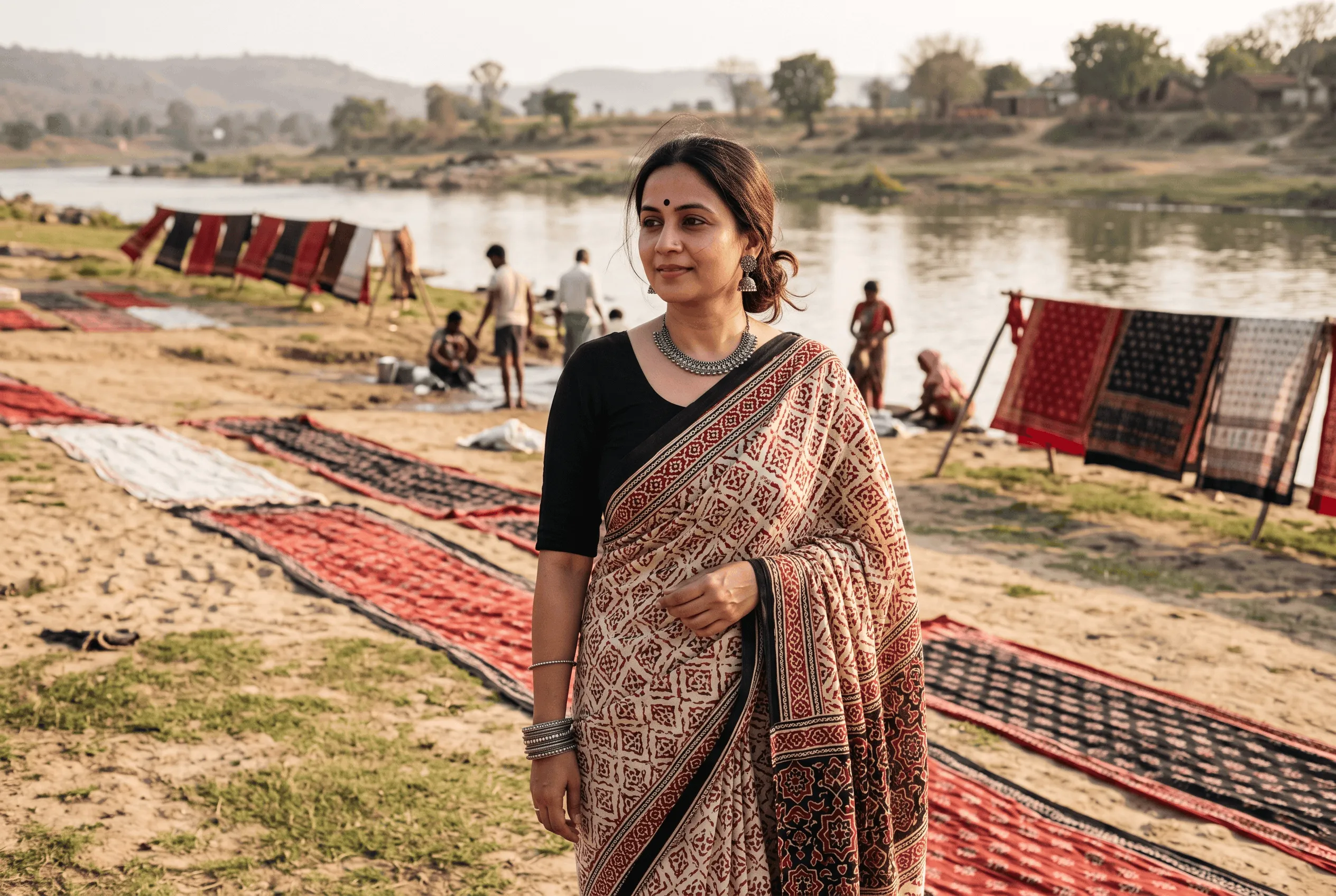
Bagh print is a hand-block printing technique from Bagh, Madhya Pradesh, that uses natural dyes and carved wooden blocks.
Its signature palette is:
Red: from alizarin (the colouring compound found in madder), fixed with alum.
Black: from iron (rusted iron mixed with jaggery and water), fixed with tannins.
Off-white: the natural colour of the fabric after treatment.
Indigo, mustard and other colours are sometimes added, but red and black on off-white remain the classic Bagh look.
A Short History
The Khatri printers trace their roots to Sindh, from where their ancestors migrated, settling in Rajasthan and later Madhya Pradesh.
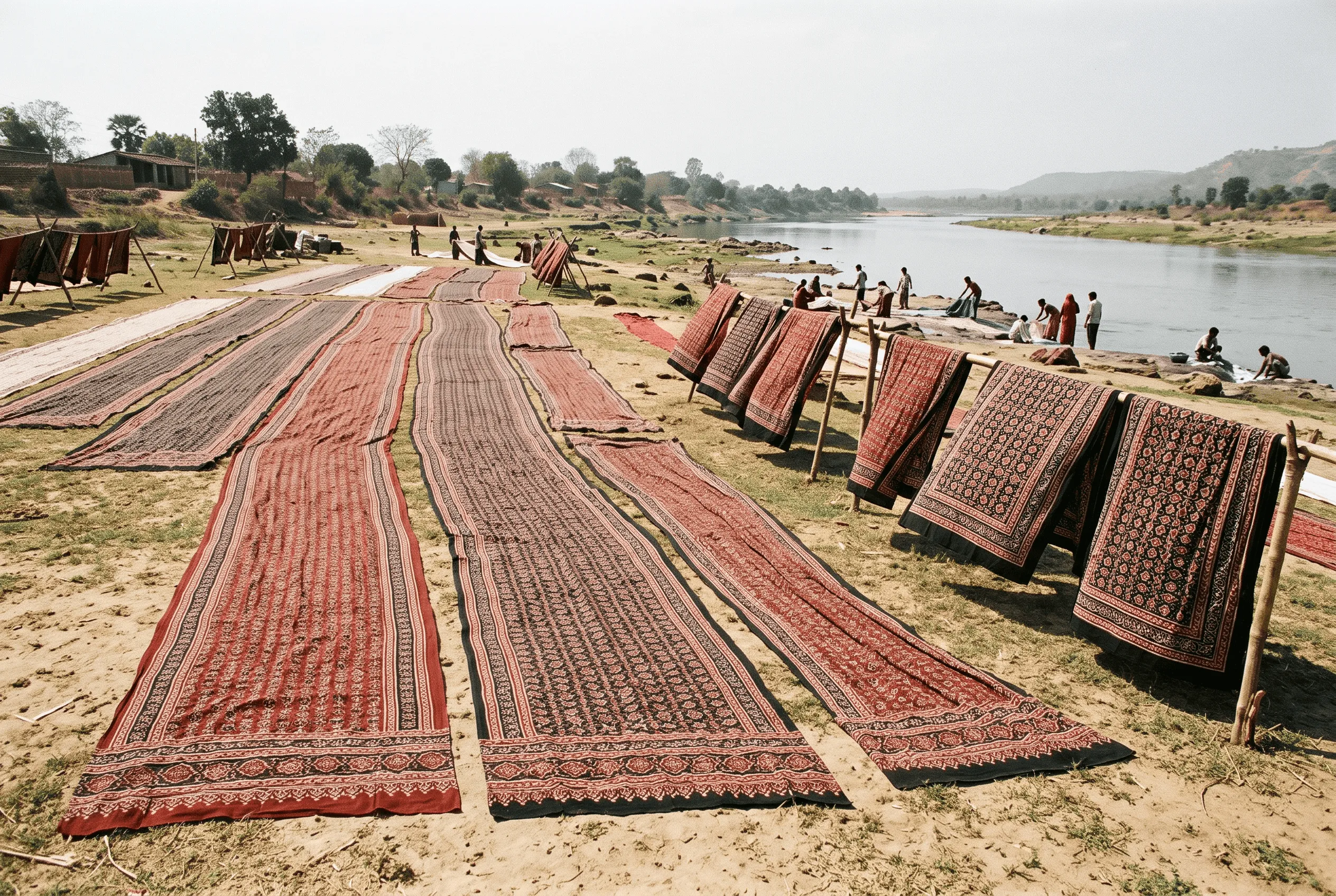
In the twentieth century, printers settled in Bagh, where the mineral-rich water of the Baghini river was ideal for washing and fixing natural dyes.
Master craftsman Ismail Sulemanji Khatri is widely credited with developing and popularising the modern Bagh print style, and his family and community have won many national awards for the craft.
The name connects the craft to the town of Bagh, which is also known for the ancient Bagh caves with their murals.
How Bagh Print Is Made
Bagh printing is a slow, multi-step process that can take a week or more for one piece.
1. Washing the fabric
Fabric is washed in the river to remove starch and impurities.
2. Pre-treatment
The fabric is treated with a mixture that typically includes harda (myrobalan), which prepares it to absorb natural dyes and gives it a pale yellow tint.
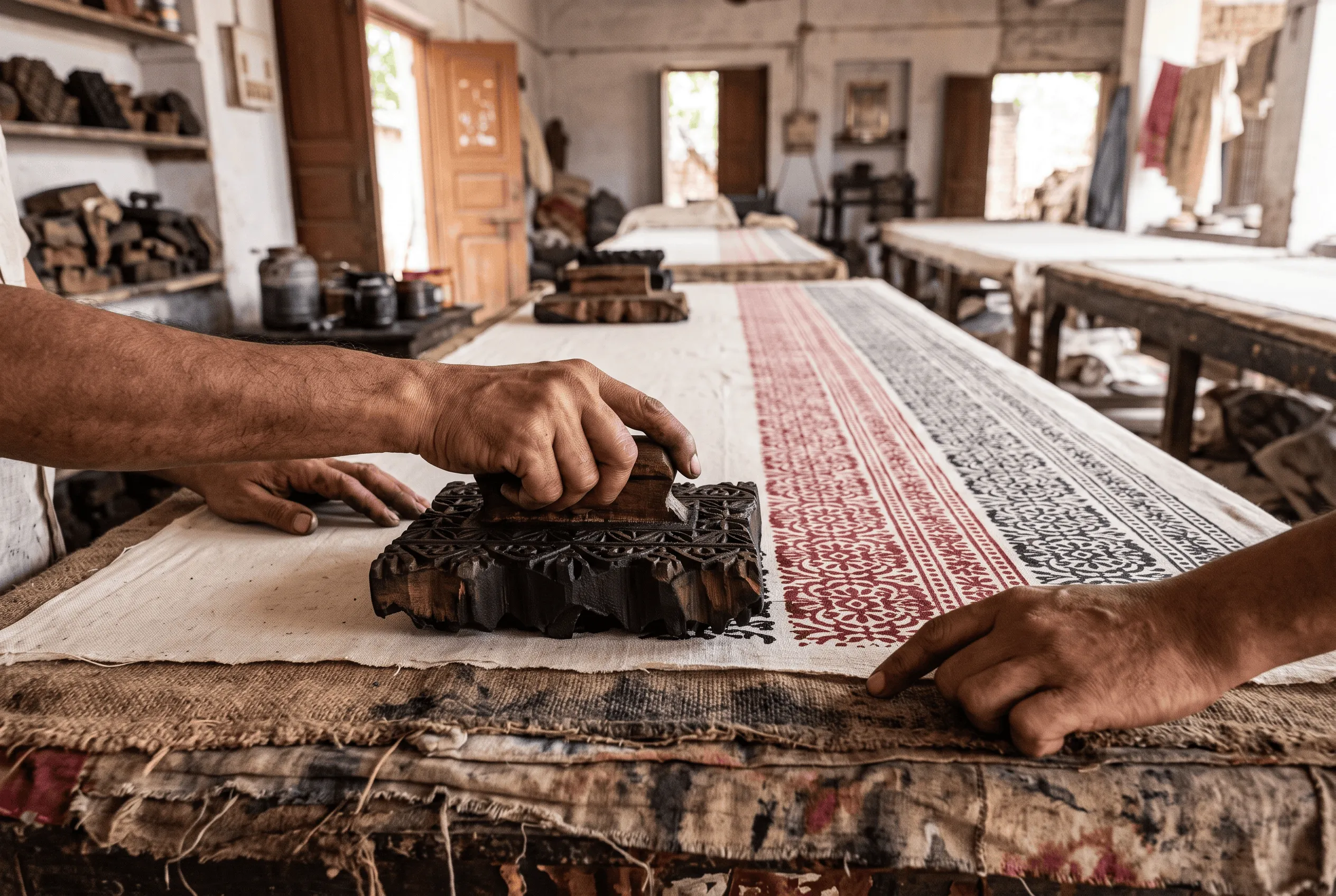
3. Block printing
Artisans dip carved teak blocks in mordant pastes and press them onto the fabric by hand.
Alum paste: where red will appear.
Iron paste: where black will appear.
Each block must be placed precisely to keep the pattern continuous.
4. Drying and resting
The printed fabric is dried and left to rest so the mordants bond with the fibres.
5. Washing in the river
The fabric is washed again in the Baghini river to remove excess paste.
6. Boiling with natural dyes
The fabric is boiled in large copper vessels with alizarin and dhawda flowers. The alum-printed areas turn red, the iron areas turn black and the background clears.
7. Final washing and sun drying
The fabric is washed and dried in the sun, which brightens the off-white background.
Bagh Print Motifs
Geometric patterns: grids, diamonds and lattices.
Floral motifs: creepers, small flowers and leaves.
Jaali patterns: inspired by carved stone screens of historic buildings.
Bagh cave-inspired designs: some motifs draw on the murals and carvings of the Bagh caves.
Mango and paisley: traditional Indian motifs.
Dense all-over prints: often with a border and pallu design on sarees.
Bagh Print vs Ajrakh
Both are natural-dye block prints linked to the Khatri community, but they look different.
Bagh: mainly red and black on an off-white base, often on cotton, Chanderi and Maheshwari, from Madhya Pradesh.
Ajrakh: deep indigo and red with intricate geometric patterns, usually printed on both sides of the fabric through resist printing, from Kutch in Gujarat and Sindh.
Bagh feels lighter and more graphic, while Ajrakh is denser and darker.
Fabrics Used
Cotton: the most common base, ideal for sarees, suits and home textiles.
Silk-cotton (Chanderi and Maheshwari): Bagh prints on Chanderi and Maheshwari bases create beautiful, lightweight sarees. See our Maheshwari handloom guide and Chanderi fabric guide.
Tussar and silk: for festive and premium sarees.
Crepe and georgette: occasionally used for modern pieces.
When to Wear Bagh Print
Office wear: cotton or Chanderi Bagh sarees with collared blouses.
Summer: breathable cotton Bagh sarees and kurtas. See our cotton sarees and suits guide.
Cultural events and exhibitions: bold red-black Bagh sarees.
Festive daywear: silk or Maheshwari Bagh prints with oxidised jewellery.
Casual outings: Bagh kurtas, dupattas and dresses.
Styling Bagh Print
Blouses
Plain black or red blouses: the classic pairing that picks up Bagh's colours.
Ajrakh or Kalamkari blouses: for an artistic mix of block-print traditions.
Collared and high-neck blouses: smart for office.
Khadi blouses: relaxed and earthy.
Jewellery
Oxidised silver: a natural match for Bagh's earthy palette.
Terracotta and wooden jewellery: for artistic looks.
Tribal-inspired pieces: bold and handcrafted.
Drapes
Nivi drape: classic and easy. See our Nivi drape tutorial.
Pleated pallu: neat for office.
Open pallu: shows off the printed pallu.
Bagh Print for Men and Home
Bagh shirts, kurtas and stoles are popular for men.
Bagh bedcovers, table linen, cushion covers and curtains bring the craft into the home.
How to Identify Genuine Bagh Print
Earthy colours: natural red and black are rich but not neon.
Slight irregularities: small variations in block alignment show hand printing.
Print on the reverse: hand-block prints usually show some colour on the reverse side, especially on cotton.
Natural dye smell and feel: genuine Bagh prints feel soft after washing.
Screen-printed copies: perfectly uniform, often brighter and flatter, with very low prices.
GI and origin details: ask whether it is printed in Bagh.
Read our authentic handloom red flags.
Price Guide
These are indicative 2026 ranges.
| Bagh print item | Indicative price range |
|---|---|
| Bagh print cotton dupatta | ₹800 – ₹2,500 |
| Bagh print cotton saree | ₹2,000 – ₹5,000 |
| Bagh print on Maheshwari or Chanderi | ₹3,500 – ₹10,000 |
| Bagh print on tussar or silk | ₹6,000 – ₹20,000+ |
Caring for Bagh Print
First washes: wash separately in cold water, as natural dyes may release a little colour.
Use mild detergent; avoid bleach.
Dry in shade to protect natural colours.
Iron on the reverse at medium heat.
Silk and silk-cotton: dry-clean.
Natural dyes soften beautifully over time and develop a lovely, lived-in look.
Choosing a Bagh Print Saree
For office: a cotton or Chanderi Bagh saree with a small, all-over geometric print and a narrow border.
For summer: a light cotton Bagh in red and black on off-white, which feels fresh and breathable.
For day functions: a Bagh print on Maheshwari or Chanderi silk-cotton, which adds a soft sheen.
For cultural events: a bold, dense Bagh print on tussar or silk with a strong pallu design.
Look closely at the edges of each motif. Hand-block prints have slight variations where one block meets the next, which is a sign of genuine handwork.
Bagh Print at Different Ages
Young women: Bagh print kurtas, dresses and dupattas with jeans or palazzos for college and casual wear.
Working women: cotton and Chanderi Bagh sarees as smart, comfortable office wear.
Older women: soft, muted Bagh prints on Maheshwari or cotton with simple silver jewellery.
Children: Bagh print cotton frocks and kurtas, which are soft and comfortable in summer.
Mixing Bagh With Other Crafts
Bagh and Maheshwari: a Bagh print on a Maheshwari base combines two Madhya Pradesh crafts in one saree.
Bagh and Chanderi: a Bagh-printed Chanderi dupatta with a plain kurta looks light and elegant.
Bagh and Kantha: a Bagh print saree with a Kantha stole creates an artistic, handcrafted look. See our Kantha stitch guide.
Bagh and khadi: a Bagh print with a khadi blouse or jacket feels earthy and sustainable.
Visiting Bagh
Bagh is in Dhar district, a few hours from Indore. Visitors can see Bagh printers at work, watch fabrics being washed and dried by the river and buy directly from printing workshops.
The nearby Bagh caves, with their ancient murals, are another reason to visit, and the town can be combined with trips to Mandu and Maheshwar.
Common Mistakes
Expecting bright, neon colours: natural dyes give rich but earthy shades, which is part of Bagh's beauty.
Washing with hot water or bleach: this can fade natural dyes quickly.
Drying in harsh sunlight for long periods: colours fade faster; dry in shade instead.
Pairing Bagh with heavy, shiny jewellery: it clashes with the earthy look; oxidised silver and terracotta work better.
Paying hand-block prices for screen prints: check for slight irregularities and the print on the reverse before buying.
Bagh Print and Sustainability
Bagh printing uses natural dyes and traditional processes, and supports artisan families in Bagh.
Choosing genuine hand-block prints over mass-produced screen prints helps sustain the craft. Our guide to sustainable handloom fashion explains why this matters.
Wearing Bagh Print
Bagh print brings the earthy beauty of Madhya Pradesh into everyday and festive wardrobes.
Wear a cotton Bagh saree for office and summer, a Bagh print Maheshwari or Chanderi for day functions and a silk Bagh for cultural events. Pair it with black blouses and oxidised jewellery, and wash it gently so the natural colours age beautifully.
Explore more in our guides to Central India handlooms: Chanderi, Maheshwari and Bagh print and on our Central India page.
Comments (0)
Leave a Thought
No comments yet. Be the first to share your thoughts!