Introduction: Understanding West Indian Ethnic Wear Fabrics
If you’re searching for West Indian ethnic wear fabrics, your intent is likely to understand which fabrics originate from Western India, what makes them unique, how to identify authentic pieces, and which fabrics are best for weddings, festivals, or everyday ethnic wear.
Having worked closely with weaving communities in Gujarat, Rajasthan, Maharashtra, and parts of Goa, and having sourced fabrics from Bhuj, Patan, Jaipur, Barmer, Paithan, and local haats, I can confidently say that West Indian fabrics are among the most vibrant, climate-adaptive, and craft-intensive textiles in India.
These fabrics are shaped by arid deserts, coastal belts, nomadic cultures, royal patronage, and tribal artistry. They are bold, expressive, and deeply symbolic—designed not just to be worn, but to be celebrated.
This guide will help you understand the history, varieties, authenticity checks, usage, and care of West Indian ethnic wear fabrics so you can choose wisely and respectfully.
History and Cultural Origins of West Indian Fabrics
Western India’s textile heritage evolved under unique geographical and cultural conditions:
- Desert climate of Rajasthan and Kutch demanded breathable yet durable fabrics
- Nomadic and tribal communities influenced bold patterns and surface embellishments
- Royal courts of Rajasthan and Maharashtra patronized luxurious silks and brocades
- Trade routes and ports (Surat, Bharuch, Goa) connected India to Africa, Persia, and Europe
Unlike the subtle elegance of Eastern fabrics or the ritual purity of Southern silks, West Indian textiles are known for dramatic colors, resist-dye techniques, and surface ornamentation like mirror work and embroidery.
Major Types of West Indian Ethnic Wear Fabrics
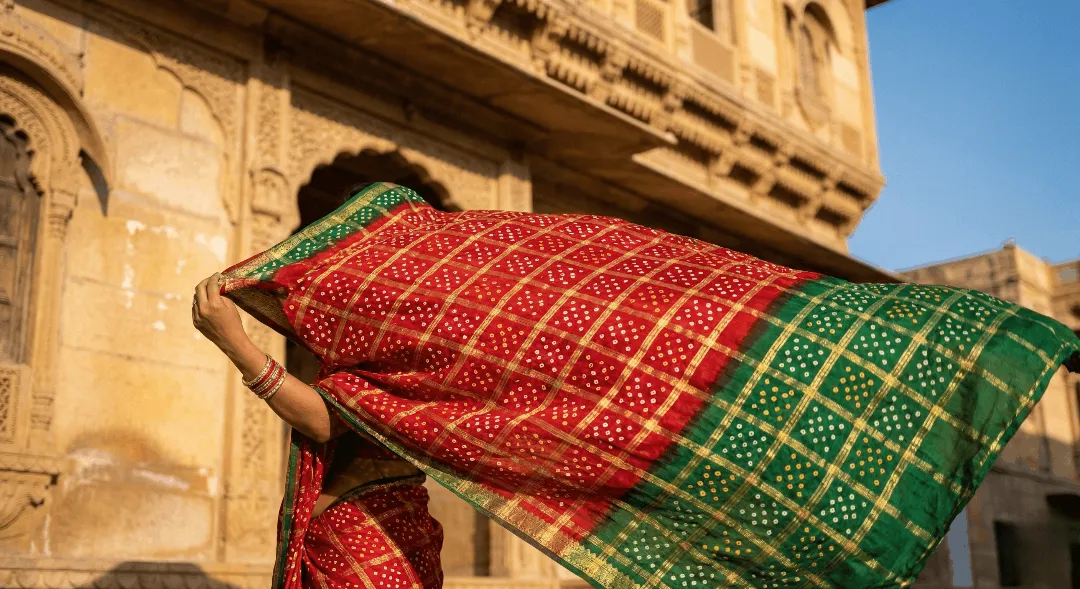
1. Bandhani (Bandhej) Fabric – Gujarat & Rajasthan
Bandhani is one of the oldest tie-and-dye techniques in the world, dating back over 5,000 years.
Key characteristics:
- Tiny tied dots creating intricate patterns
- Bright colors like red, yellow, green, and blue
- Cotton, silk, or georgette base
- Each dot is hand-tied—no two pieces are identical
Bandhani is widely worn during weddings, Navratri, Teej, and festive rituals.
2. Patola Silk – Patan, Gujarat
Patola is a double ikat silk, considered one of India’s most complex and prestigious textiles.
Key characteristics:
- Both warp and weft are tie-dyed
- Perfectly symmetrical designs on both sides
- Pure silk with geometric and cultural motifs
- Extremely time-consuming to produce
Authentic Patola sarees can take 6 months to a year to complete.
3. Kutch Embroidered Fabrics – Gujarat
Kutch textiles are famous for hand embroidery, mirror work, and bold colors, created by various tribal communities.
Key characteristics:
- Cotton or wool base
- Mirror (shisha) work
- Bright threads and symbolic motifs
- Each community has a distinct embroidery style
4. Leheriya Fabric – Rajasthan
Leheriya is another resist-dye technique known for its wave-like diagonal stripes.
Key characteristics:
- Lightweight cotton, silk, or georgette
- Bright festive colors
- Popular during monsoons and festivals
Leheriya is strongly associated with Jaipur and Rajasthani culture.
5. Ajrakh Fabric – Gujarat & Rajasthan
Ajrakh is a block-printed and resist-dyed fabric, traditionally worn by pastoral communities.
Key characteristics:
- Natural dyes (indigo, madder)
- Reversible prints
- Deep blue, red, and black tones
- Strong geometric symmetry
6. Paithani Silk – Maharashtra
Paithani is Maharashtra’s pride and one of India’s most luxurious silks.
Key characteristics:
- Pure silk with real gold zari
- Peacock, lotus, and vine motifs
- Rich pallu with contrasting borders
- Handwoven using tapestry technique
Paithani sarees are often family heirlooms.
How to Identify Quality and Authenticity
1. Tie-Dye Precision
- In authentic Bandhani, dots are tiny and uniform
- Printed dots indicate imitation
2. Pattern Alignment
- True Patola designs are identical on both sides
- Misalignment means powerloom replica
3. Fabric Feel
- Handwoven fabrics feel breathable and natural
- Synthetic blends feel slippery and overly shiny
4. Natural Dye Indicators
- Ajrakh colors are deep but never fluorescent
How to Identify Quality and Authenticity
1. Tie-Dye Precision
- In authentic Bandhani, dots are tiny and uniform
- Printed dots indicate imitation
2. Pattern Alignment
- True Patola designs are identical on both sides
- Misalignment means powerloom replica
3. Fabric Feel
- Handwoven fabrics feel breathable and natural
- Synthetic blends feel slippery and overly shiny
4. Natural Dye Indicators
- Ajrakh colors are deep but never fluorescent
Uses and Occasions
| Fabric | Best Uses |
|---|---|
| Bandhani | Weddings, festivals, rituals |
| Patola Silk | Grand weddings, heirloom wear |
| Kutch Embroidery | Navratri, cultural events |
| Leheriya | Seasonal festivals, casual ethnic |
| Ajrakh | Daily wear, sustainable fashion |
| Paithani | Weddings, formal ceremonies |
Care and Maintenance Tips (From Practical Experience)
- Always dry clean silk fabrics
- Bandhani cotton can be hand-washed gently
- Avoid soaking dyed fabrics for long
- Store silks wrapped in cotton cloth
- Refold zari sarees every 6 months
Common Myths and Buying Mistakes
Myth 1: All tie-dye fabrics are Bandhani
Reality: True Bandhani is hand-tied, not printed.
Myth 2: Brighter colors mean better quality
Reality: Natural dyes are rich but subtle.
Common Mistake:
Buying Patola replicas without checking reverse pattern clarity.
Comments (0)
Leave a Thought
No comments yet. Be the first to share your thoughts!