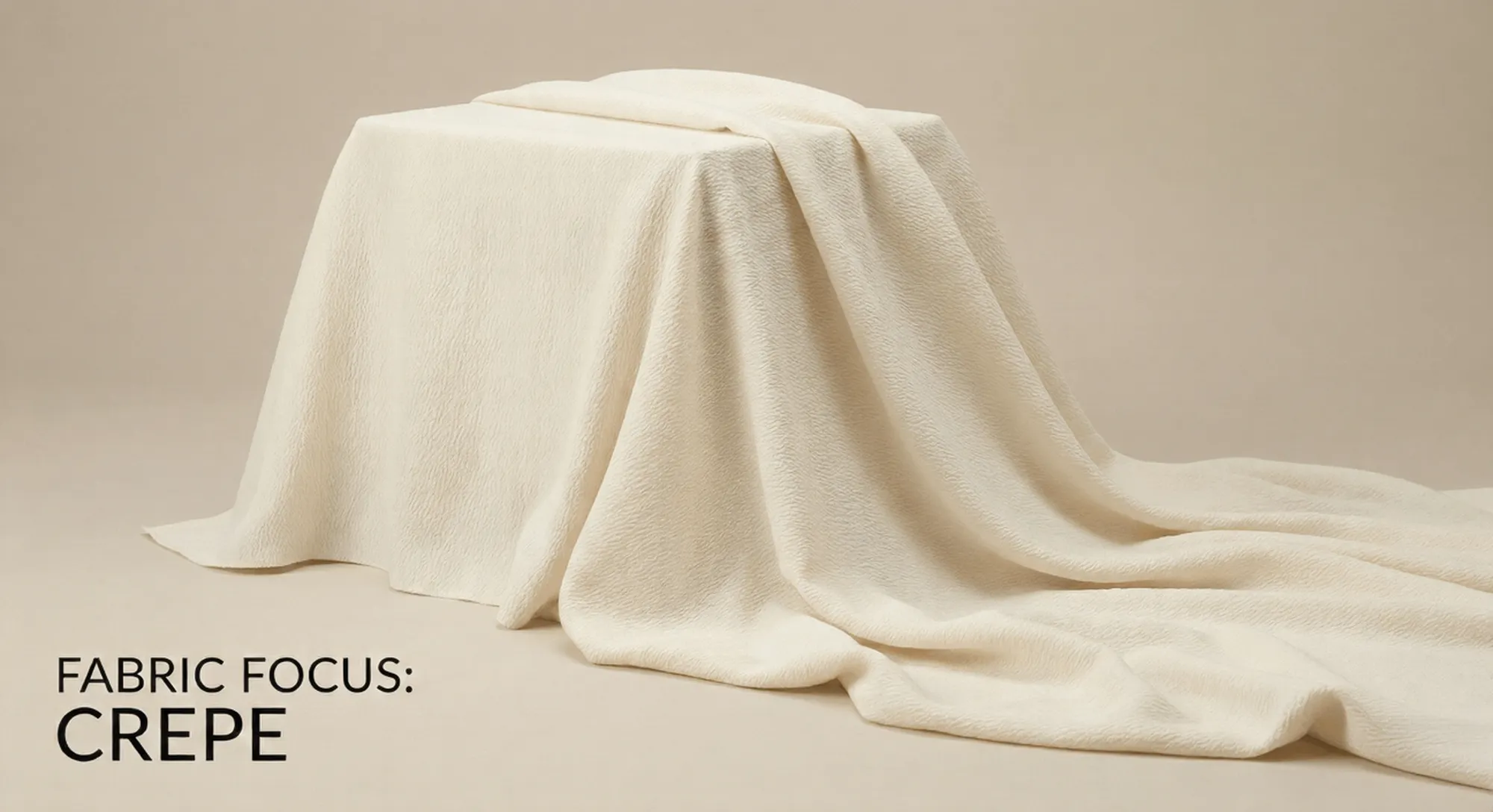
Introduction: Why Crepe Fabric Still Matters Today
Crepe fabric has survived centuries of fashion changes not because of trends, but because of performance. It adapts. It moves. It complements the body instead of controlling it. From traditional sarees to modern dresses and tailored suits, crepe continues to remain relevant across generations.
Unlike flat fabrics that rely heavily on prints or embellishment, crepe’s strength lies in its surface engineering and drape behavior. This blog explores crepe fabric as a living textile, from its historical roots to its modern applications, without repeating generic explanations. If you want real clarity for learning, buying, or content creation, this guide is built for that purpose.
Origins of Crepe: From Ritual Fabric to Everyday Elegance
Crepe was not created for fashion first. Historically, it was valued for its restrained appearance and non-reflective surface. Early silk crepes were worn in Europe during ceremonial occasions where subtlety was preferred over shine.
Indian Adaptation of Crepe
When crepe entered India, it underwent a transformation. Indian climates demanded better airflow, and Indian clothing styles demanded better drape. Weavers adjusted yarn twist levels and fabric weight, making crepe suitable for:
- Sarees that flow without stiffness
- Salwar suits that resist clinging
- Garments that move well in humidity
Over time, crepe shifted from being a formal textile to an everyday luxury fabric.
What Truly Defines Crepe Fabric (Beyond the Name)
Many fabrics are mistakenly sold as crepe based on appearance alone. In reality, crepe is defined by controlled instability within the yarn structure.
The Science Behind the Texture
Crepe yarns are twisted beyond normal limits. When woven, these yarns attempt to untwist, but are locked into position by the weave. This internal stress creates:
- Micro-wrinkles
- Grainy or pebbled surfaces
- Natural elasticity
This is why crepe feels alive in the hand, unlike flat fabrics.
Fibers Used in Crepe and How They Change Behavior
The same crepe structure behaves very differently depending on the fiber used.
Natural Fiber Crepe
- Silk crepe: High breathability, elegant fall, temperature regulating
- Wool crepe: Springy, resilient, excellent shape retention
Regenerated Fiber Crepe
- Rayon crepe: Soft, absorbent, comfortable but delicate when wet
Synthetic Fiber Crepe
- Polyester crepe: Stable, wrinkle-resistant, long-lasting
Each fiber alters how crepe responds to heat, moisture, and wear.
Types of Crepe Fabric Explained by Function
Rather than listing types only by name, it is more useful to understand what each crepe is designed to do.
Silk Crepe
Designed for drape and comfort. Ideal for garments worn close to the skin.
Crepe de Chine
Engineered for smoothness with minimal texture. Preferred where softness matters more than grain.
Georgette Crepe
Designed for lightness and movement. Works best in layered or flowing silhouettes.
Polyester Crepe
Built for endurance. Suitable for daily wear, uniforms, and travel clothing.
Wool Crepe
Designed for structure with flexibility. Common in suits and tailored outfits.
How Crepe Performs Compared to Flat Fabrics
Crepe behaves differently because it is three-dimensional in structure.
Key Performance Advantages
- Less fabric cling
- Better crease masking
- Enhanced drape without added weight
- Improved comfort during movement
This makes crepe especially valuable for Indian wear, where garments are worn for long hours.
Identifying Good Crepe Fabric (Buyer’s Insight)
High-quality crepe does not look perfect at first glance. Instead, it shows controlled irregularity.
What to Look For
- Texture that feels consistent, not flat
- Fabric that springs back after gentle crushing
- Balanced weight, not overly stiff or flimsy
Red Flags
- Printed texture instead of real crinkle
- Fabric that becomes flat after washing
- Excessive shine claiming to be silk crepe
Comfort & Wearability Across Climates
Crepe excels in thermal comfort, especially when made from natural or semi-natural fibers.
- Textured surface creates air pockets
- Reduced skin contact lowers sweat discomfort
- Drapes away from the body instead of sticking
This is why crepe sarees and dresses are preferred in warm and humid regions.
Care Behavior: Why Crepe Needs Respect, Not Fear
Crepe is often avoided because it is believed to be difficult to maintain. In reality, it only requires correct handling.
Fabric-Appropriate Care
- Avoid aggressive washing
- Control heat exposure
- Allow fabric to rest between wears
Crepe lasts longer when its natural elasticity is preserved.
Misunderstandings That Affect Buying Decisions
- Crepe is weak – ❌
- Crepe is always synthetic – ❌
- Crepe is unsuitable for tailoring – ❌
Most failures occur due to wrong fiber choice, not crepe structure itself.

Comments (0)
Leave a Thought
No comments yet. Be the first to share your thoughts!